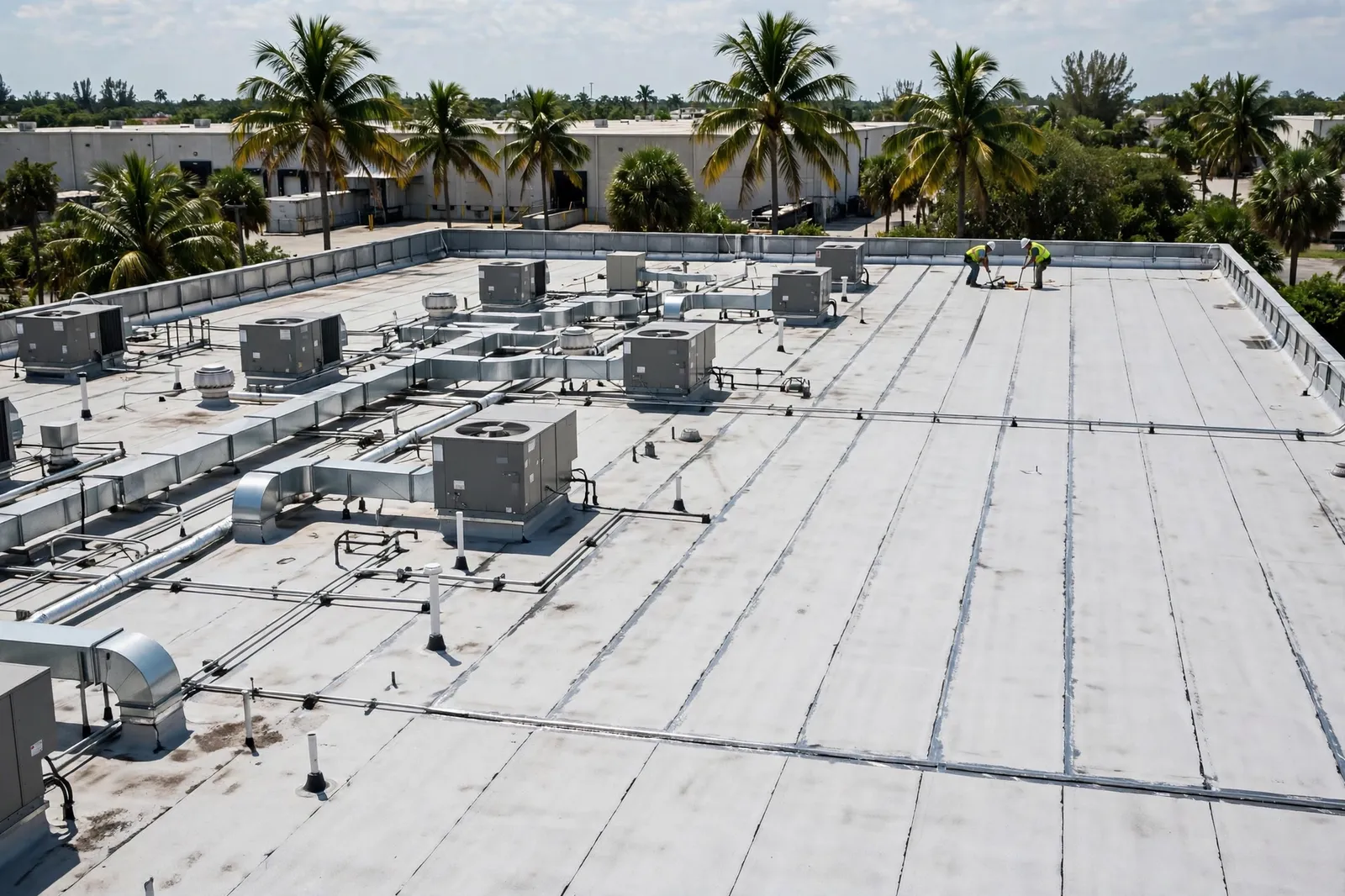
Commercial Roofing - Jacksonville Metro
Commercial Roofing in Jacksonville, FL
Across Jacksonville and 10 nearby cities, commercial roofing is scoped, documented, and priced in the open. One call connects you with an independent roofer who covers your part of the metro.
Serving Jacksonville and 10 nearby cities Open 24/7 for emergencies
Commercial roofing in Jacksonville covers flat and low-slope repair, coating, and replacement for warehouses, retail, offices, and multi-family buildings, plus the maintenance programmes that stop small leaks becoming stock damage. Call (725) 765-9243 and we will connect you with a local contractor who covers Jacksonville.
What commercial roofing work is covered in Jacksonville?
Commercial roofing in Jacksonville covers flat and low-slope repair, coating, and replacement for warehouses, retail, offices, and multi-family buildings, plus the maintenance programmes that stop small leaks becoming stock damage.
Commercial roofs fail at details: seams, curbs, drains, and penetrations. The field of the roof is usually the last part to go, so condition reports are organised detail by detail.
- Low-slope membrane repair on TPO, modified bitumen, and built-up roofs
- Leak tracing across large roof fields and around HVAC curbs
- Drainage correction for ponding sections and clogged drains
- Roof coating systems where the existing membrane qualifies
- Full re-roof planning with phased scheduling around operations
- Documented condition reports for owners, managers, and buyers
Work starts with a condition survey: core samples or scans where moisture is suspected, seam probing, and a drainage map after rain. Repairs are quoted per section with photos. Larger jobs are phased so the building stays watertight every night and operations keep running, with a named contact and a written schedule the property manager holds.
Commercial diagnostics are moisture accounting at scale. A roof field can look sound while insulation under it holds water from a seam that opened two seasons ago. Survey work therefore combines seam probing, drain and pond mapping, and moisture verification at suspect areas, so the repair plan targets the wet sections and leaves the dry ones alone. That targeting is where commercial budgets are saved.
Maintenance programmes are where commercial roofing becomes predictable: two documented visits a year, drains cleared, seams probed, details renewed before they open. Buildings on a programme file their condition reports like clockwork and stop having emergency line items. Buildings off programme pay for the same work at emergency rates, plus whatever the water touched inside.
Jacksonville housing runs from 1920s bungalows in the urban core to post-war ranch homes, 1990s subdivisions, and new master-planned communities at the edges. The St. Johns River bends through the middle of the metro, so humidity, afternoon thunderstorm build-up off the river, and oak canopy shade shape roof ageing on both banks.
The local pattern shifts street by street. In Orange Park South, age and corridor exposure drive Orange Park South work: worn valley metal, patched leak histories, and roofs that need an honest repair-versus-replacement read. In Bellair-Meadowbrook Terrace, old stock is the Bellair-Meadowbrook Terrace factor: layered repairs, ageing flashing at chimneys and additions, and dense oak shade keeping slopes damp.
How much does commercial roofing cost in Jacksonville?
Commercial roofing in Jacksonville is quoted per section after a condition survey, because building size and roof condition vary too widely for one range.
Roof size, access, membrane type, wet insulation extent, and whether work phases around operating hours set commercial pricing. Section repairs are quoted individually; coating and replacement are quoted per square foot after the condition survey. The survey itself is the document every later decision rests on.
Commercial systems are specified by assembly: TPO and PVC membranes with welded seams, modified bitumen in torch or cold-applied builds, and coating systems matched to the existing membrane chemistry. Compatibility between the existing roof and any new layer is verified in writing, because an incompatible coating or patch is a future leak with a warranty argument attached.
The ranges behave the same way on every job. Small, accessible, and local is the low end. Large, steep, layered, or hiding secondary damage is the high end. A homeowner reading a quote for commercial roofing in Jacksonville should be able to point at the line that places the job where it sits, and a proper quote makes that line obvious.
The metro's commercial roofs sit on its warehouses by the port and airport, its retail corridors, its medical and office parks, and thousands of apartment and condo buildings. Their shared conditions are Florida conditions at scale: ponding after daily summer rain, seams ageing in high ultraviolet, and storm seasons that test every detail annually. Condition reporting, not emergency response, is what keeps those roofs economical.
The full material-by-material breakdown sits in the Jacksonville roof replacement cost guide, so any quote for this work can be checked line by line. The roofer states the exact price after inspection and before any work starts.
Local housing shifts the figure inside the range. Fleming Island: Fleming Island is planned-community housing from the 1990s and 2000s: two-story homes with architectural shingles under HOA colour and material rules. Atlantic Beach: Atlantic Beach housing is small-lot beach bungalows, cottages under the pine canopy, and renovated coastal homes near the Mayport end. Middleburg: Middleburg housing is rural-suburban: ranch homes and manufactured homes on acreage lots, metal-roofed outbuildings, and newer subdivisions along the Blanding corridor.
A roof file pays off again at resale in Jacksonville. Buyers and their inspectors read the permit record, the dated photographs, and the warranty before they argue about price, and a complete file answers most of their questions before they are asked. Keeping the paperwork from any job arranged through this site is part of the job's value.
Documentation is the thread through every stage of a roofing job in Jacksonville. The inspection photographs the roof before anyone quotes it, the quote prices what the photographs show, and the finished work is photographed again so the file closes with evidence. Homeowners who keep that file hold the strongest position in any later insurance, warranty, or resale conversation.
Warranty paperwork deserves the same attention as the work itself in Jacksonville. The written quote should state what the workmanship warranty covers and for how long, in plain words, before the job starts. Verbal assurances do not survive staff changes or storm seasons; the document does, and homeowners should keep it with the permit record.
What happens when roof damage is left through a wet season?
Left through another storm cycle, a small failure becomes decking rot: water follows the slope and the framing, and the repair grows from a detail fix into section work. For a business roof, the condition report separates urgent leaks from the monitor list, so stock and trading hours stay protected.
What are the signs a commercial roof in Jacksonville needs work?
A commercial leak over stock, servers, or patient space is an emergency in plain terms. Temporary containment and a same-visit patch protect the operation while the permanent section repair is scheduled. Recurring stains at the same drain line mean the drainage fix, not another patch, is the next spend.
Ponding from settled insulation and blocked drains is the leading local cause, followed by seam ageing under ultraviolet exposure, punctures from foot traffic and dropped tools around HVAC units, and storm debris. Tenants report stains late, so small entries often run long before the first call.
Jobs are phased around the building's life: noisy and odorous stages scheduled with management, daily dry-in guaranteed in writing, and a single named contact on both sides. The property receives progress photos as sections close, and the final file holds the condition report, the scope as built, and the maintenance schedule the roof now runs on.
Timing in northeast Florida follows the storm calendar. The weeks before June are for inspections and the repairs they find, because summer afternoons test every seal on the roof. Autumn is the second window, after the tropical season, when storm damage is documented and planned work books fastest. Commercial Roofing booked in those windows avoids the post-storm queue entirely.
The causes repeat with local accents. Atlantic Beach: Atlantic Beach roofs take direct ocean weather: salt spray at every fastener, sand-laden wind, and pine straw that mats on low-slope sections and in valleys after every storm. Middleburg: Middleburg's pine flatwoods shed needles onto every roof, and big open lots give afternoon storms a clear run at eaves and ridge lines with no neighbouring houses to break the wind.
From the Trout River to Matanzas Inlet the inputs barely change: daily summer rain, canopy debris, salt near the coast, and heat everywhere. The defects that follow are the metro's shared list, which is why one documented standard covers Jacksonville and all ten cities around it.
Materials staging tells its own story on a Jacksonville job. Shingles, panels, or tiles arrive before the tear-off starts, sit protected off the ground, and leave no offcuts scattered through the planting beds. A tidy site at the end of day one is the earliest visible sign of how carefully the hidden layers are being laid.
Attic condition quietly decides how a roof ages in Jacksonville. Ventilation that moves summer heat out of the attic extends the life of sealants, underlayment, and the covering itself, while a sealed, superheated attic cooks all three. Inspections booked through this site check the attic side as a matter of course, and ventilation corrections are quoted separately when they are found.
Site care is part of how a professional crew works in Jacksonville: landscaping protected before ladders go up, debris into a bin rather than across the yard, and a magnetic sweep for nails before the crew leaves. It costs the roofer little and tells the homeowner a great deal about how the invisible parts of the work above were handled.
How are commercial roof jobs run in Jacksonville?
Repair sections while moisture is local. Coat when the membrane is ageing but dry and seams test tight. Replace when wet insulation spreads or the membrane is at end of life. The condition report with moisture findings makes the recommendation auditable for owners and boards.
Work follows the membrane manufacturer's details and the Florida Building Code for the building's occupancy and wind zone, with permits where the scope requires them. Documentation follows an owner-grade standard: condition reports with located photos and moisture findings that a manager, buyer, or lender can rely on without visiting the roof.
Before the visit, three things help: the age of the roof if it is known, any paperwork from prior work, and a note of exactly where water, noise, or debris has shown itself. None of it is required, and the inspection proceeds without it, but the report gets sharper and the quote gets tighter when the facts arrive with the roofer.
Minor work of this kind typically needs no permit in Duval County. Structural deck work and full replacement need a Duval County permit under the Florida Building Code, and the roofer pulls the permit and schedules the inspections before work starts.
A documented survey through roof inspection in Jacksonville, FL gives the decision its evidence base. My Jacksonville Roofer is a connection service, not a roofing company. The service connects the homeowner with an independent roofer serving Jacksonville in Duval County. One call to (725) 765-9243 starts the process.
The final walkthrough closes the work in Jacksonville. The roofer walks the roof and the ground with the homeowner, points to each repaired or replaced detail, and hands over the closing photographs and paperwork. Anything that looks wrong gets named on that walk, while the crew and the ladders are still on site.
Insurance files run through much of this work in Florida. Dated photographs, a written scope, and a clear separation between sudden damage and wear are what a claim needs, and they are produced as a matter of routine on jobs arranged through this site in Jacksonville. The homeowner files the claim; the paperwork arrives ready.
Commercial Roofing across the Jacksonville metro
Every city in the metro has its own commercial roofing page, written for its own housing, roads, and weather.
Jacksonville BeachCommercial Roofing in Jacksonville BeachPonte Vedra BeachCommercial Roofing in Ponte Vedra BeachOrange ParkCommercial Roofing in Orange ParkFleming IslandCommercial Roofing in Fleming IslandAtlantic BeachCommercial Roofing in Atlantic BeachMiddleburgCommercial Roofing in MiddleburgNeptune BeachCommercial Roofing in Neptune BeachGreen Cove SpringsCommercial Roofing in Green Cove SpringsSaint AugustineCommercial Roofing in Saint AugustineSaint JohnsCommercial Roofing in Saint Johns
Popular Jacksonville neighbourhoods for commercial roofing
Neighbourhood-level commercial roofing pages sit under their city pages, so homeowners find a page written for their own streets.
Related services in Jacksonville
Flat Roof Repair in JacksonvillePonding, seams, and membrane patches for low-slope roofs and additionsRoof Repair in JacksonvilleLeak repair, shingle replacement, and flashing work with published price rangesRoof Inspection in JacksonvilleEvery slope, the flashing, and the attic, with dated photos and a written summaryRoof Replacement Cost in JacksonvillePublished ranges and the factors that move a quote, so any price can be checkedHow It Works
How do you book through this site?
1
Call
Call (725) 765-9243 and describe the problem: a leak, storm damage, an aging roof, or a cost question.
2
Get connected
We connect you with an independent roofing contractor who covers your part of the Jacksonville metro.
3
Get your roof assessed
The contractor inspects the roof and gives you their price and timeline directly. You decide whether to go ahead.
Commercial Roofing questions, answered
The owner or property manager named on the call receives the condition report, photos, and written quote directly. My Jacksonville Roofer is a connection service, not a roofing company; the independent roofer who surveys and does the work issues the documents and stands behind them. A twice-yearly inspection file is what buyers and lenders ask for; it starts with the condition report.
Re-roofing and structural work need permits in Duval County under the Florida Building Code, and the roofer handles applications and inspections. Section repairs below the code thresholds are documented in the job file instead. Permit status is stated in the written quote before work begins. Drain and pond mapping after rain is the cheapest diagnostic in commercial roofing.
A specialist records the property address, building type, roof size if known, and whether a leak is active. The specialist connects the manager with an independent commercial roofer serving Jacksonville. The survey and written quote follow from the roofer directly. Coating decisions wait on seam and moisture evidence, never on the membrane's appearance alone.
Commercial repairs in Jacksonville are quoted per section after a condition survey, because size and moisture extent vary too widely for a flat range. Residential-scale flat sections follow the published repair ranges. The written quote separates survey findings, repair scope, and any coating or replacement options so owners can budget by stage. Ask for the moisture findings, not just the leak location; wet insulation decides the real scope.
Yes. Commercial jobs are phased, with daily dry-in, debris control, and work windows agreed with management. Odour-sensitive operations get low-odour systems and off-hours scheduling for the loudest stages. The plan is written into the quote, not improvised on the day. Daily dry-in during phased work belongs in the written plan, not as a verbal promise.