Emergency Roof Repair - Jacksonville Metro
Emergency Roof Repair in Jacksonville, FL
Across Jacksonville and 10 nearby cities, emergency roof repair is scoped, documented, and priced in the open. One call connects you with an independent roofer who covers your part of the metro.
Serving Jacksonville and 10 nearby cities Open 24/7 for emergencies
Emergency roof repair in Jacksonville covers active water entry, storm-torn shingles, fallen limbs through the deck, and failed flashing during a storm, secured first with tarping or a temporary seal. Call (725) 765-9243 and we will connect you with a local contractor who covers Jacksonville.
What counts as a roof emergency in Jacksonville?
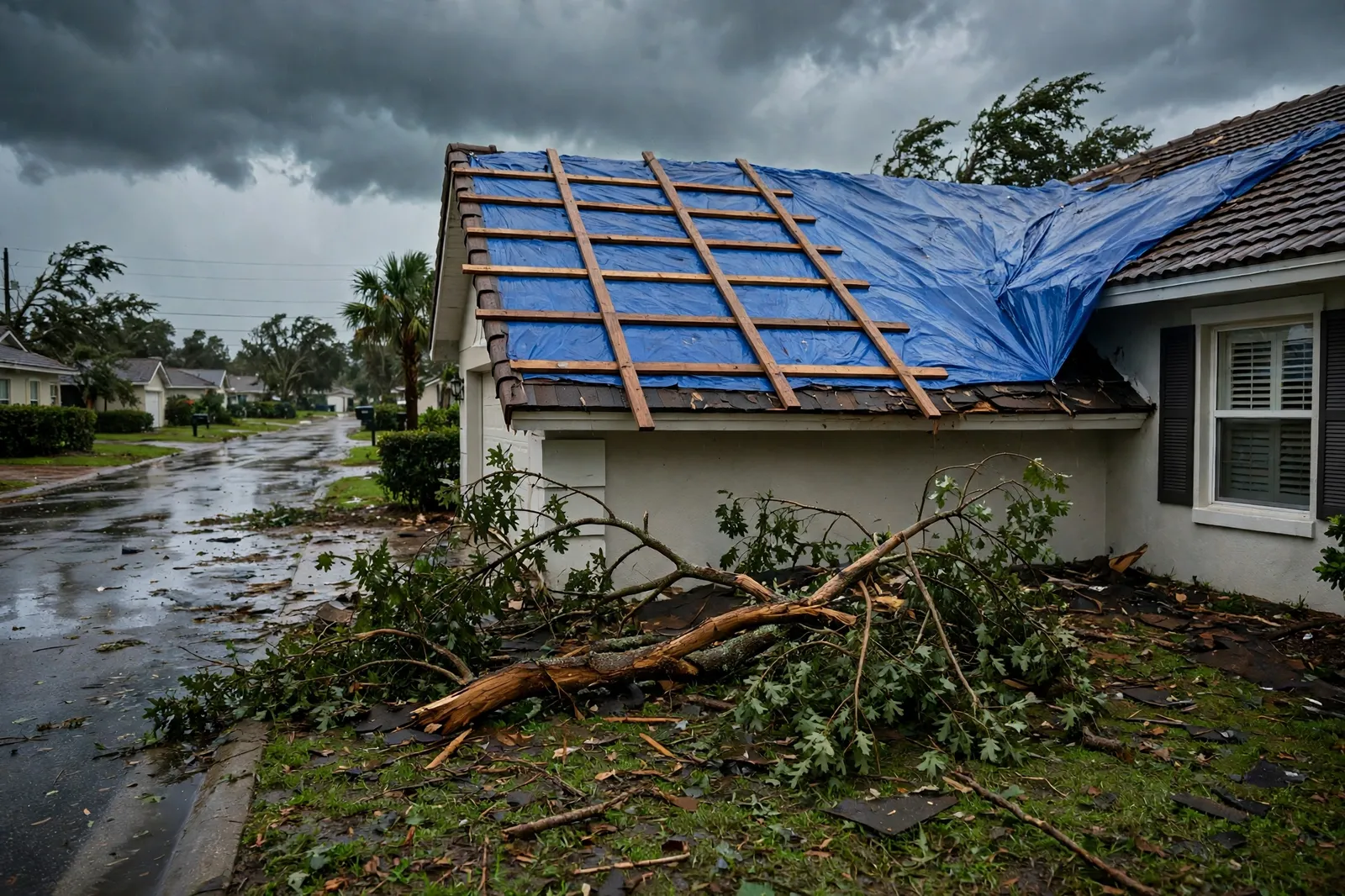
Emergency roof repair in Jacksonville covers active water entry, storm-torn shingles, fallen limbs through the deck, and failed flashing during a storm, secured first with tarping or a temporary seal.
The emergency visit has one job: stop the water. Permanent repairs are scoped and priced separately once the roof is dry and fully inspected.
- Emergency tarping over torn or punctured roof sections
- Temporary seals on storm-lifted shingles and flashing
- Fallen limb removal coordination and deck puncture cover
- Active leak containment at valleys and vent penetrations
- Storm damage documentation with dated photos for claims
- Scheduling of the permanent repair once the roof is dry
The call comes first. A specialist records the address, the damage, and whether water is entering now. The roofer secures the opening with a tarp anchored to sound decking or applies a temporary seal, photographs every damaged slope for the claim file, and checks the attic for wet decking. The permanent repair is then quoted in writing from the documented damage.
Good tarping is a technique, not a sheet and a prayer. The tarp extends past the damaged area onto sound roof on every side, its edges are sandwiched between boards screwed into rafters rather than nailed through the roof field, and the top edge sheds water over, never under. A tarp fastened wrong becomes a funnel, which is why storm-week photos of the securing work matter.
The second visit is where emergencies are won or lost. Temporary seals shrink and tarps chafe at their anchor lines as days pass, so a storm week schedule includes re-checks rather than assuming the first night's work still holds. Homeowners are told plainly which openings are tarp-only and which received a built temporary patch, because the two behave very differently in the next band of rain.
Jacksonville housing runs from 1920s bungalows in the urban core to post-war ranch homes, 1990s subdivisions, and new master-planned communities at the edges. The St. Johns River bends through the middle of the metro, so humidity, afternoon thunderstorm build-up off the river, and oak canopy shade shape roof ageing on both banks.
The local pattern shifts street by street. In Julington Creek, Creek-side humidity and a mature planted canopy load Julington Creek valleys, and the whole community's builder roofs age in step. In Durbin Crossing, Durbin Crossing roofs are young; early sealant and boot failures from the build years are the common calls, caught best by inspection.
How much does emergency roof repair cost in Jacksonville?
Minor emergency roof repair in Jacksonville costs $350 to $1,200, and larger work costs $1,200 to $3,500.
Emergency securing is priced on access, roof pitch, the size of the opening, and whether a tarp or a built temporary patch is safer. The permanent repair behind it follows the standard ranges: minor repair $350 to $1,200, larger repair $1,200 to $3,500. Night and storm-week demand affects scheduling, and the specialist states the current position on the call.
Emergency kits are built around heavy woven tarps, 2x4 anchoring boards, cap nails and screws, roofing cement for tab reseals, and plywood for deck punctures. Crews carry the sizes that fit typical Jacksonville ranch and two-story roofs so the first visit ends with the home dry, not with a shopping list.
Consider how a quote is built. The roofer measures the roof, lists the defects the inspection photographed, and prices labour and materials against that list. Two homes on the same Jacksonville street can land hundreds of dollars apart because one needs flashing rebuilt and the other needs a seal and a course of shingles. The range absorbs both; the written quote separates them.
Jacksonville's emergency map is drawn by its storms: the Beaches and the river point take the wind, the low streets near Black Creek and the Trout River take the water, and the oak-heavy neighbourhoods take the limbs. Crews staged across the metro answer in that order after a major system. A homeowner who calls early, photographs immediately, and keeps the address in the queue holds the best position in that map.
The full material-by-material breakdown sits in the Jacksonville roof replacement cost guide, so any quote for this work can be checked line by line. Every figure here is a range on purpose: the written quote after inspection is the exact number.
Local housing shifts the figure inside the range. Jacksonville Beach: Jacksonville Beach housing mixes 1950s beach cottages, ranch homes west of A1A, and newer two-story coastal builds on narrow lots. Ponte Vedra Beach: Ponte Vedra Beach homes are larger coastal builds, many with concrete tile or standing seam metal roofs, inside gated and golf-course communities. Orange Park: Ranch homes built from the 1960s through the 1980s dominate Orange Park streets, with newer subdivisions toward Oakleaf on the west side.
Site care is part of how a professional crew works in Jacksonville: landscaping protected before ladders go up, debris into a bin rather than across the yard, and a magnetic sweep for nails before the crew leaves. It costs the roofer little and tells the homeowner a great deal about how the invisible parts of the emergency roof repair above were handled.
Attic condition quietly decides how emergency roof repair ages in Jacksonville. Ventilation that moves summer heat out of the attic extends the life of sealants, underlayment, and the covering itself, while a sealed, superheated attic cooks all three. Inspections booked through this site check the attic side as a matter of course, and ventilation corrections are quoted separately when they are found.
Why does roof damage need prompt attention?
Roof damage needs prompt attention because water often travels beyond the first visible stain.
How fast can emergency help reach Jacksonville?
Water entering now is the emergency. Buckets, towels, and moving belongings protect the inside while help travels. If a limb is on the roof or wires are down, keep people and pets out of the room below until the roofer confirms the structure is safe.
Jacksonville emergencies follow the weather: summer thunderstorms with straight-line winds, tropical systems pushing bands of sideways rain, and oak limbs coming down on roofs at 2 a.m. Age sets up the failure; the storm triggers it.
After the securing visit, the sequence is inspection, written quote, then permanent repair on a stated date. The homeowner receives the photo set from the emergency visit first, because the claim clock may already be running. If another storm band is forecast before the repair date, the crew re-checks the tarp rather than assuming it held.
Jacksonville roofs are inspected on a Florida calendar, not a northern one: before the June storms, after the last tropical system, and whenever a stain or a lifted tab appears between those points. Emergency Roof Repair sits inside that rhythm. The inspection report from the quiet season is the document that makes the loud season manageable.
The causes repeat with local accents. Atlantic Beach: Atlantic Beach roofs take direct ocean weather: salt spray at every fastener, sand-laden wind, and pine straw that mats on low-slope sections and in valleys after every storm. Middleburg: Middleburg's pine flatwoods shed needles onto every roof, and big open lots give afternoon storms a clear run at eaves and ridge lines with no neighbouring houses to break the wind.
Across the metro, the pattern repeats from the river to the beaches: afternoon storms build over the St. Johns River, oak canopy holds moisture on shaded slopes, and summer heat ages sealants years faster than northern roofs experience. That is why the same defect shows up across Jacksonville, the Beaches, Clay County, and St. Johns County in the same seasons.
Scheduling honesty matters as much as the work in Jacksonville. A roofer who gives a real window, calls when weather moves it, and says plainly where a job sits in the queue is showing the same reliability the roof itself needs. This site passes timing questions through to the contractor on the first call, so expectations are set by the people who will actually do the emergency roof repair.
Insurance files run through much of this work in Florida. Dated photographs, a written scope, and a clear separation between sudden damage and wear are what a claim needs, and they are produced as a matter of routine on jobs arranged through this site in Jacksonville. The homeowner files the claim; the paperwork arrives ready.
What happens after the emergency repair in Jacksonville?
Secure first, decide second. Once the roof is dry and inspected, the same repair-versus-replacement rules apply: isolated damage on a sound roof gets repaired; a storm that exposes an already failing surface moves the conversation to replacement with the photos as evidence.
Securing work respects the same safety and code logic as permanent work: no roof access during lightning or unsafe wind, anchors into structure rather than sheathing alone where possible, and no temporary measure that damages sound material the permanent repair will need. Documentation follows the visit the same day.
Homeowners can make the visit count for more. Clear a path to the attic hatch, note when any leak or noise started, and keep prior roof paperwork with the inspection report when it arrives. Photographs taken from the ground after storms build the timeline that supports both warranty and insurance conversations later.
Minor work of this kind typically needs no permit in Duval County. Structural deck work and full replacement need a Duval County permit under the Florida Building Code, and the roofer pulls the permit and schedules the inspections before work starts.
A documented survey through roof inspection in Jacksonville, FL gives the decision its evidence base. The introduction is the whole of what this site does in Jacksonville: a specialist takes the call, records the roof problem, and connects the homeowner with an independent roofer covering that part of Duval County. The roofer inspects, quotes, and does the work. Call (725) 765-9243 to start.
Documentation is the thread through every stage of emergency roof repair in Jacksonville. The inspection photographs the roof before anyone quotes it, the quote prices what the photographs show, and the finished work is photographed again so the file closes with evidence. Homeowners who keep that file hold the strongest position in any later insurance, warranty, or resale conversation.
Warranty paperwork deserves the same attention as the work itself in Jacksonville. The written quote should state what the workmanship warranty covers and for how long, in plain words, before the job starts. Verbal assurances do not survive staff changes or storm seasons; the document does, and homeowners should keep it with the permit record.
Emergency Roof Repair across the Jacksonville metro
Every city in the metro has its own emergency roof repair page, written for its own housing, roads, and weather.
Jacksonville BeachEmergency Roof Repair in Jacksonville BeachPonte Vedra BeachEmergency Roof Repair in Ponte Vedra BeachOrange ParkEmergency Roof Repair in Orange ParkFleming IslandEmergency Roof Repair in Fleming IslandAtlantic BeachEmergency Roof Repair in Atlantic BeachMiddleburgEmergency Roof Repair in MiddleburgNeptune BeachEmergency Roof Repair in Neptune BeachGreen Cove SpringsEmergency Roof Repair in Green Cove SpringsSaint AugustineEmergency Roof Repair in Saint AugustineSaint JohnsEmergency Roof Repair in Saint Johns
Popular Jacksonville neighbourhoods for emergency roof repairs
Neighbourhood-level emergency roof repairs pages sit under their city pages, so homeowners find a page written for their own streets.
Related services in Jacksonville
Roof Repair in JacksonvilleLeak repair, shingle replacement, and flashing work with published price rangesStorm Damage Roof Repair in JacksonvilleSecuring, photo documentation, and repair after Jacksonville stormsRoof Leak Repair in JacksonvilleEntry-point tracing and sealing, not just stain covering, with honest rangesRoof Replacement Cost in JacksonvillePublished ranges and the factors that move a quote, so any price can be checkedHow It Works
How do you book through this site?
1
Call
Call (725) 765-9243 and describe the problem: a leak, storm damage, an aging roof, or a cost question.
2
Get connected
We connect you with an independent roofing contractor who covers your part of the Jacksonville metro.
3
Get your roof assessed
The contractor inspects the roof and gives you their price and timeline directly. You decide whether to go ahead.
Emergency Roof Repair questions, answered
Move belongings out of the drip path, place buckets under active drips, and photograph the damage from the ground and inside the attic if it is safe. Do not climb on a wet roof. Note when the water started and what the storm did; that timeline goes into the claim documentation. Securing and permanent repair are quoted as separate lines, so mitigation costs stay clear for the claim.
Florida policies cover sudden storm damage, and emergency tarping is usually part of the covered mitigation. Keep the dated photos and the written damage report with the claim. Wear and pre-existing slow leaks sit outside cover, and the roofer's report separates storm damage from age honestly. Keep belongings out of the drip path until the permanent repair, not just the tarp, is complete.
No. A tarp is a temporary cover that protects the home until the permanent repair is scoped and done. Tarps are checked and replaced if a storm week stretches the schedule. The written quote for the permanent repair follows the standard published ranges on this site. The specialist can state the current emergency queue position honestly on the call.
The securing work is priced on access, pitch, and opening size, and the specialist explains the basis on the call. Permanent repairs behind the emergency follow the published ranges: $350 to $1,200 for minor repair and $1,200 to $3,500 for larger repair. Nothing beyond the agreed securing work is charged without a written quote. The emergency photo set is dated and kept with the claim file from the first visit.
Roof work stops during lightning and high wind for crew safety. The call still matters during the storm: the specialist logs the address, gives containment steps for inside the home, and queues the visit for the first safe window. Most Jacksonville storm bands pass within hours. If more rain is forecast before the permanent repair, ask for a tarp re-check on the same call.