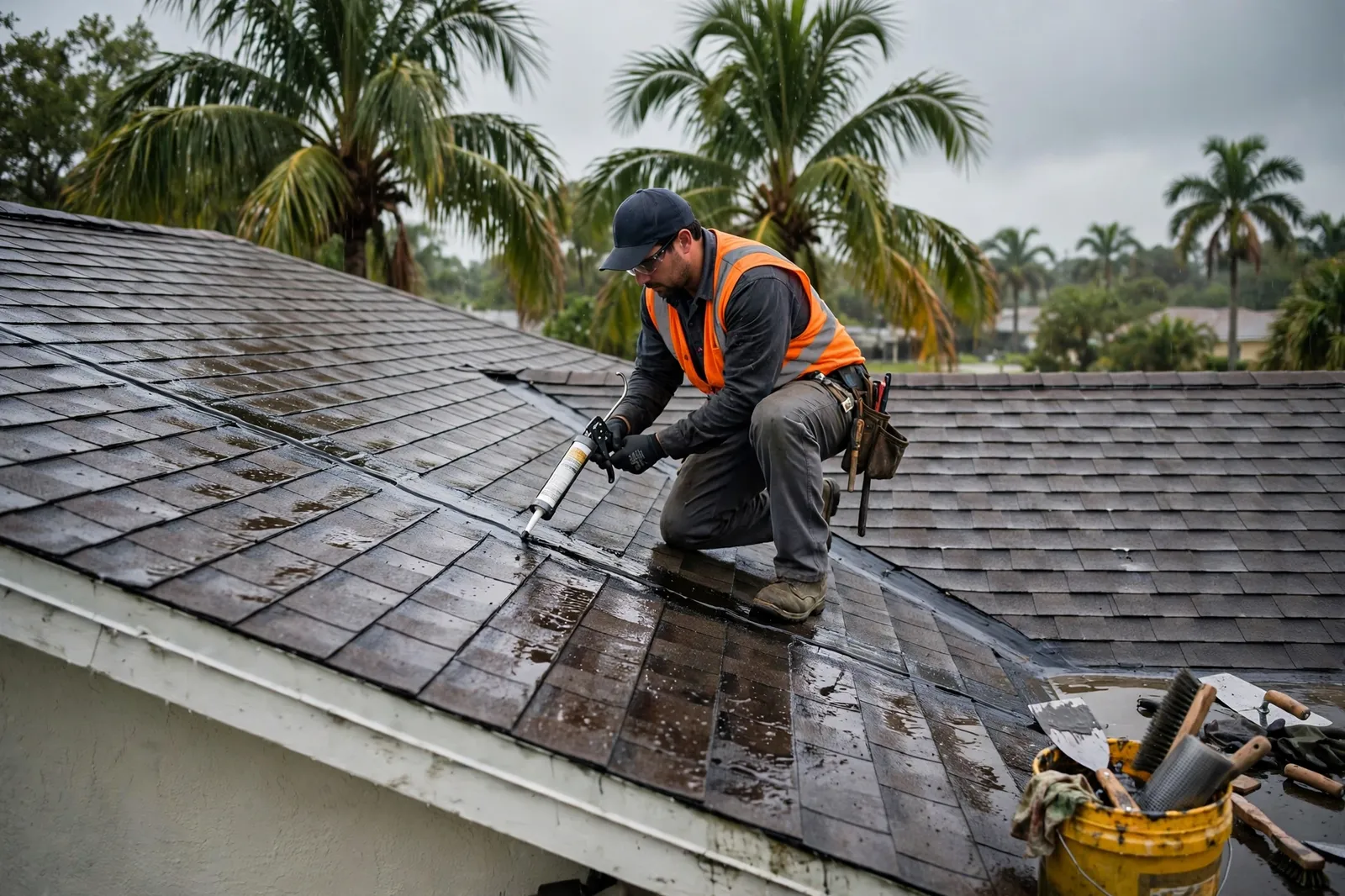
Roof Leak Repair - Jacksonville Metro
Roof Leak Repair in Jacksonville, FL
Across Jacksonville and 10 nearby cities, roof leak repair is scoped, documented, and priced in the open. One call connects you with an independent roofer who covers your part of the metro.
Serving Jacksonville and 10 nearby cities Open 24/7 for emergencies
Roof leak repair in Jacksonville means tracing the true entry point, usually at flashing, valleys, vent boots, or lifted shingles, and sealing the source instead of just covering the stain. Call (725) 765-9243 and we will connect you with a local contractor who covers Jacksonville.
What causes roof leaks in Jacksonville homes?
Roof leak repair in Jacksonville means tracing the true entry point, usually at flashing, valleys, vent boots, or lifted shingles, and sealing the source instead of just covering the stain.
A stain in one room rarely sits under the hole. Water runs along decking and rafters before it drips, so honest leak work starts with tracing, not patching.
- Entry-point tracing from attic stain to roof opening
- Flashing reseals at chimneys, walls, dormers, and skylights
- Valley repairs where debris holds water against the metal
- Vent boot and pipe flashing replacement
- Shingle course replacement around the entry point
- Water testing of the finished repair before sign-off
The roofer starts in the attic with a light, reading the stain trail on the decking and following it upslope. On the roof, the crew lifts the courses around the suspected entry point, checks the underlayment, and reseals or replaces the failed component. The repair finishes with a controlled water test from a hose, run from the eave upward until the entry point proves dry.
Tracing technique matters more than sealant. Inspectors read the geometry of the stain: a round stain under a flat ceiling usually sits near the entry, while a long stain follows a rafter or a seam and points upslope. Moisture meters confirm which decking is wet, and the roof check then works a grid uphill of the wettest point until the failed component is found.
Moisture mapping is the second half of tracing. A leak that has run for months leaves a footprint in decking and insulation wider than the stain suggests, and the repair scope follows the footprint, not the drip. Sections of decking that have lost their stiffness are replaced inside the repair, because sealing a roof over soft decking only schedules the next call.
Jacksonville housing runs from 1920s bungalows in the urban core to post-war ranch homes, 1990s subdivisions, and new master-planned communities at the edges. The St. Johns River bends through the middle of the metro, so humidity, afternoon thunderstorm build-up off the river, and oak canopy shade shape roof ageing on both banks.
The local pattern shifts street by street. In Murray Hill, small steep roofs and old chimneys concentrate Murray Hill work at flashing lines, and its tight lots make ladder and debris logistics part of every job. In Historic Springfield, tall Victorian geometry, ageing layers, and restoration expectations make Springfield roof work a documentation exercise as much as a repair.
How much does leak repair cost in Jacksonville?
Roof Leak Repair in Jacksonville is priced in two bands: minor work at $350 to $1,200, and larger work at $1,200 to $3,500.
The entry point sets the price. A split vent boot is a low-end repair. A failed valley or chimney flashing rebuild costs more because courses come off and go back on in sequence. Attic access, pitch, and how long the leak ran before detection move the figure inside each range.
Leak repairs use the component that failed, not a generic substitute: rubber and lead boot flashings matched to pipe diameter, step and apron flashing in corrosion-resistant metal, valley metal in the original gauge, and shingle courses woven to match. Sealant is the last line, never the only one, because Florida sun gives exposed sealant a short life.
Consider how a quote is built. The roofer measures the roof, lists the defects the inspection photographed, and prices labour and materials against that list. Two homes on the same Jacksonville street can land hundreds of dollars apart because one needs flashing rebuilt and the other needs a seal and a course of shingles. The range absorbs both; the written quote separates them.
Leak work in Jacksonville follows the water. The St. Johns River bends the storm tracks, the Beaches take the wind first, and inland neighbourhoods sit under oak canopy that keeps roofs wet for days after rain. Each pattern grows a different family of leaks: flashing and corrosion at the coast, valley and debris leaks under the canopy, and wind-lifted tabs on the open inland lots. Tracing that starts from the local pattern finds entry points faster.
The full material-by-material breakdown sits in the Jacksonville roof replacement cost guide, so any quote for this work can be checked line by line. Every figure here is a range on purpose: the written quote after inspection is the exact number.
Local housing shifts the figure inside the range. Jacksonville Beach: Jacksonville Beach housing mixes 1950s beach cottages, ranch homes west of A1A, and newer two-story coastal builds on narrow lots. Ponte Vedra Beach: Ponte Vedra Beach homes are larger coastal builds, many with concrete tile or standing seam metal roofs, inside gated and golf-course communities. Orange Park: Ranch homes built from the 1960s through the 1980s dominate Orange Park streets, with newer subdivisions toward Oakleaf on the west side.
Scheduling honesty matters as much as the work in Jacksonville. A roofer who gives a real window, calls when weather moves it, and says plainly where a job sits in the queue is showing the same reliability the roof itself needs. This site passes timing questions through to the contractor on the first call, so expectations are set by the people who will actually do the work.
Materials staging tells its own story on a Jacksonville job. Shingles, panels, or tiles arrive before the tear-off starts, sit protected off the ground, and leave no offcuts scattered through the planting beds. A tidy site at the end of day one is the earliest visible sign of how carefully the hidden layers are being laid.
Why should roof damage be checked before the next storm?
Left through another storm cycle, a small failure becomes decking rot: water follows the slope and the framing, and the repair grows from a detail fix into section work. Leak repair starts by tracing the water to its true entry point, so the fix lands on the source rather than the stain.
Can a leak wait, or is it an emergency in Jacksonville?
A growing stain means water is still moving. Every rain cycle pushes moisture further into decking, insulation, and drywall, and a minor repair can become a larger one within weeks. Active leaks get emergency priority; a stain that has not changed in months still needs tracing before the next storm season.
Most leaks start at interruptions in the roof surface: flashing joints, vent penetrations, and valleys. Florida heat splits rubber vent boots, afternoon storms drive rain sideways under lifted tabs, and oak and pine debris dams valleys so water ponds against seams it was never meant to sit on.
Expect the visit to start inside, not on the roof. The attic check comes first, with photos of the stain trail and any daylight at penetrations. Roof work follows, the component is replaced, and the hose test closes the job. Most traced repairs finish in a single visit; the exception is a valley or flashing rebuild, which is quoted separately before it starts.
Jacksonville roofs are inspected on a Florida calendar, not a northern one: before the June storms, after the last tropical system, and whenever a stain or a lifted tab appears between those points. Roof Leak Repair sits inside that rhythm. The inspection report from the quiet season is the document that makes the loud season manageable.
The causes repeat with local accents. Jacksonville Beach: Salt air reaches every roof in Jacksonville Beach. Metal components corrode faster, shingle sealant ages in constant sun, and onshore storms drive rain horizontally against east-facing slopes. Ponte Vedra Beach: Oceanfront exposure drives the roofing story in Ponte Vedra Beach: salt spray, high UV, and storm surge wind zones that demand strict fastening patterns on tile and metal systems.
The same weather writes the same defects across the whole metro. Storms form over the river and roll to the beaches, oak shade keeps north slopes damp for days, and summer heat cooks sealant years ahead of a northern schedule, so neighbourhoods forty minutes apart present the same failures in the same months.
Weather windows shape every schedule in Jacksonville. Summer work starts early to beat the afternoon storms, and a crew that watches the radar rather than the clock alone finishes sealed before the rain arrives. Homeowners hear about weather moves from the contractor directly, with the new time stated on the same call.
The final walkthrough closes the work in Jacksonville. The roofer walks the roof and the ground with the homeowner, points to each repaired or replaced detail, and hands over the closing photographs and paperwork. Anything that looks wrong gets named on that walk, while the crew and the ladders are still on site.
How do roofers trace a leak in Jacksonville?
One traced leak on a sound roof is a repair. Leaks appearing at several unrelated points in the same season usually mean the surface itself is at end of life, and replacement becomes the honest recommendation. Soft or stained decking found during tracing also pushes the scope from seal work into repair or replacement.
A traced repair is finished only when it passes a controlled water test run in sections from the eave upward, isolating the entry point the way rain finds it. Repairs that skip the test are guesses with invoices. The roofer records the test and the component replaced, so if water ever shows again, the next visit starts from evidence instead of zero.
Homeowners can make the visit count for more. Clear a path to the attic hatch, note when any leak or noise started, and keep prior roof paperwork with the inspection report when it arrives. Photographs taken from the ground after storms build the timeline that supports both warranty and insurance conversations later.
Minor work of this kind typically needs no permit in Duval County. Structural deck work and full replacement need a Duval County permit under the Florida Building Code, and the roofer pulls the permit and schedules the inspections before work starts.
A documented survey through roof inspection in Jacksonville, FL gives the decision its evidence base. Homeowners in Jacksonville deal with the roofer directly from the first inspection. This site makes the introduction only: it is not the roofing company, it does not set the price, and it does not warrant the work. One call to (725) 765-9243 opens the conversation.
A roof file pays off again at resale in Jacksonville. Buyers and their inspectors read the permit record, the dated photographs, and the warranty before they argue about price, and a complete file answers most of their questions before they are asked. Keeping the paperwork from any job arranged through this site is part of the job's value.
Documentation is the thread through every stage of a roofing job in Jacksonville. The inspection photographs the roof before anyone quotes it, the quote prices what the photographs show, and the finished work is photographed again so the file closes with evidence. Homeowners who keep that file hold the strongest position in any later insurance, warranty, or resale conversation.
Roof Leak Repair across the Jacksonville metro
Every city in the metro has its own roof leak repair page, written for its own housing, roads, and weather.
Jacksonville BeachRoof Leak Repair in Jacksonville BeachPonte Vedra BeachRoof Leak Repair in Ponte Vedra BeachOrange ParkRoof Leak Repair in Orange ParkFleming IslandRoof Leak Repair in Fleming IslandAtlantic BeachRoof Leak Repair in Atlantic BeachMiddleburgRoof Leak Repair in MiddleburgNeptune BeachRoof Leak Repair in Neptune BeachGreen Cove SpringsRoof Leak Repair in Green Cove SpringsSaint AugustineRoof Leak Repair in Saint AugustineSaint JohnsRoof Leak Repair in Saint Johns
Popular Jacksonville neighbourhoods for roof leak repairs
Neighbourhood-level roof leak repairs pages sit under their city pages, so homeowners find a page written for their own streets.
Related services in Jacksonville
Roof Repair in JacksonvilleLeak repair, shingle replacement, and flashing work with published price rangesRoof Inspection in JacksonvilleEvery slope, the flashing, and the attic, with dated photos and a written summaryEmergency Roof Repair in JacksonvilleTarping and urgent securing when water is entering, day or nightRoof Replacement Cost in JacksonvillePublished ranges and the factors that move a quote, so any price can be checkedHow It Works
How do you book through this site?
1
Call
Call (725) 765-9243 and describe the problem: a leak, storm damage, an aging roof, or a cost question.
2
Get connected
We connect you with an independent roofing contractor who covers your part of the Jacksonville metro.
3
Get your roof assessed
The contractor inspects the roof and gives you their price and timeline directly. You decide whether to go ahead.
Roof Leak Repair questions, answered
Policies cover leaks caused by sudden events such as storm damage or a fallen limb. Slow leaks from worn flashing or age sit outside cover in most Florida policies. Dated photos of the damage and a written tracing report support the claim file either way. The tracing report names the component that failed, which is the detail insurers and buyers both ask for.
A tarp or bucket buys time, and roofing cement on an obvious lifted tab can slow a drip for one storm. Most DIY seals fail because the entry point is not where the stain is. If the stain grows or returns after rain, the leak needs professional tracing before decking damage spreads. A water test result is recorded on the job file, so the repair is proven, not assumed.
Tracing and sealing a single entry point usually finishes in one visit of 2 to 4 hours. Valley and flashing rebuilds take most of a day. If the tracing finds deck damage, the roofer explains the added scope and price before any extra work begins. If tracing finds a second entry point, it is photographed and quoted before any extra work happens.
A specialist records the address, the stain location, and when the leak appears. The specialist connects the homeowner with an independent roofer serving Jacksonville who traces and seals the entry point. My Jacksonville Roofer is a connection service, not a roofing company. Keep the tracing photos; they show exactly where water travelled if a stain ever reappears nearby.
Tracing and sealing a single entry point in Jacksonville usually falls in the minor repair range of $350 to $1,200. A valley or flashing rebuild sits in the larger range of $1,200 to $3,500. The roofer confirms the exact figure after the entry point is found, because the entry point sets the scope. The entry point and the repair are marked on a roof diagram in the written report.