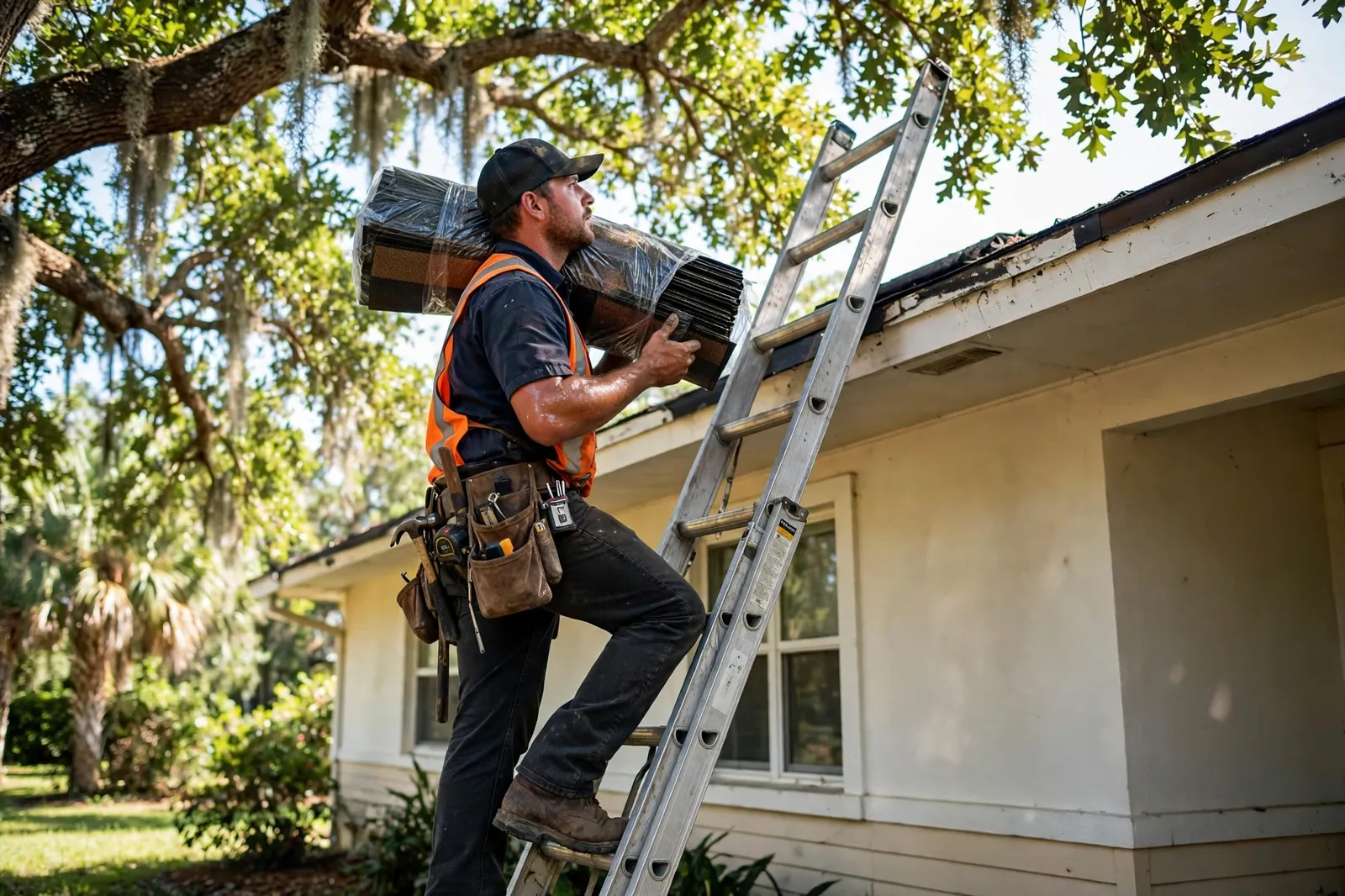
Roofer - Jacksonville Metro
Roofer in Jacksonville, FL
Across Jacksonville and 10 nearby cities, roofer is scoped, documented, and priced in the open. One call connects you with an independent roofer who covers your part of the metro.
Serving Jacksonville and 10 nearby cities Open 24/7 for emergencies
A roofer in Jacksonville inspects roofs, traces leaks, repairs shingle, tile, metal, and flat systems, and installs full replacements. Call (725) 765-9243 and we will connect you with a local contractor who covers Jacksonville.
What does a roofer in Jacksonville actually do?
A roofer in Jacksonville inspects roofs, traces leaks, repairs shingle, tile, metal, and flat systems, and installs full replacements. One call to this site connects a homeowner with an independent local roofer who covers the area.
Roofer is the word homeowners use; the work is specific. Inspections, repairs, and replacements each have their own process and price range, all published on this site.
- Leak tracing from attic stain to roof entry point
- Shingle, tile, metal, and flat roof repair
- Full roof replacement with permit and inspections
- Storm securing, tarping, and documented damage reports
- Roof inspections with dated photos and written findings
- Written quotes before any work, with no obligation
The roofer starts with the roof, not the sale: a walk of every slope, an attic check where leaks are involved, and dated photos of every defect. Findings come back in writing, sorted into what needs attention now and what can wait, with the quote separated from the report so the facts stand on their own.
A good roofer's visit is recognisable from the ladder up: slopes walked in a pattern, tabs lifted by hand, flashing checked with eyes and fingers, and photos taken before opinions are offered. The attic gets the same respect, because the underside of the roof confirms or kills every theory the surface suggested. Homeowners can judge the visit by that order: evidence first, conclusions second.
The roofer's eye is trained on sequence: what failed first, what it wetted, and what it will take next. That ordering is what an inspection report is really selling. A homeowner reading one should be able to follow the chain from a split boot to a stained ceiling to the decking decision, because the roofer who can explain the chain is the one who actually found it.
Jacksonville housing runs from 1920s bungalows in the urban core to post-war ranch homes, 1990s subdivisions, and new master-planned communities at the edges. The St. Johns River bends through the middle of the metro, so humidity, afternoon thunderstorm build-up off the river, and oak canopy shade shape roof ageing on both banks.
The local pattern shifts street by street. In Anastasia Island, Two-sided water exposure gives Anastasia Island roofs salt air from both directions and nor'easter rain that lasts for days. In Vilano Beach, Vilano Beach roofs take the metro's most direct ocean weather: salt at every fastener and wind that arrives with no land to slow it.
How much does a roofer charge in Jacksonville?
Work booked through a roofer in Jacksonville follows the published ranges: inspection $150 to $400, minor repair $350 to $1,200, larger repair $1,200 to $3,500, replacement $12,000 to $38,000.
The roofer's prices follow the ranges published across this site: inspection $150 to $400, minor repair $350 to $1,200, larger repair $1,200 to $3,500, replacement $12,000 to $38,000. Job size, material, pitch, and deck condition place a specific job inside its range, and the written quote states the exact figure.
Roofers carry loyalties to material lines they trust, and a straight answer about why is a good sign. What matters for the homeowner is that the quote names the system being installed or repaired (profile, underlayment, flashing metal, fastener spec) so the work can be checked against the published ranges and the manufacturer's own instructions.
Consider how a quote is built. The roofer measures the roof, lists the defects the inspection photographed, and prices labour and materials against that list. Two homes on the same Jacksonville street can land hundreds of dollars apart because one needs flashing rebuilt and the other needs a seal and a course of shingles. The range absorbs both; the written quote separates them.
A Jacksonville roofer's year has a shape: spring inspections, summer storm response, autumn planned work, and the insurer-letter rush whenever carriers review roof ages. Homeowners who understand that shape time their calls inside it, booking inspections in the quiet weeks and keeping the emergency line for the loud ones. The roofers who serve the metro well are the ones whose reports and photos make every season's work easier.
The full material-by-material breakdown sits in the Jacksonville roof replacement cost guide, so any quote for this work can be checked line by line. Every figure here is a range on purpose: the written quote after inspection is the exact number.
Local housing shifts the figure inside the range. Jacksonville Beach: Jacksonville Beach housing mixes 1950s beach cottages, ranch homes west of A1A, and newer two-story coastal builds on narrow lots. Ponte Vedra Beach: Ponte Vedra Beach homes are larger coastal builds, many with concrete tile or standing seam metal roofs, inside gated and golf-course communities. Orange Park: Ranch homes built from the 1960s through the 1980s dominate Orange Park streets, with newer subdivisions toward Oakleaf on the west side.
Attic condition quietly decides how roofer ages in Jacksonville. Ventilation that moves summer heat out of the attic extends the life of sealants, underlayment, and the covering itself, while a sealed, superheated attic cooks all three. Inspections booked through this site check the attic side as a matter of course, and ventilation corrections are quoted separately when they are found.
Site care is part of how a professional crew works in Jacksonville: landscaping protected before ladders go up, debris into a bin rather than across the yard, and a magnetic sweep for nails before the crew leaves. It costs the roofer little and tells the homeowner a great deal about how the invisible parts of the roofer above were handled.
Why does roof damage need prompt attention?
Roof damage needs prompt attention because water often travels beyond the first visible stain.
When should you call a roofer in Jacksonville?
Water entering now goes first. Everything else queues by type: inspections and assessments inside 24 to 48 hours in normal weeks. The earlier a stain is traced, the smaller the repair behind it stays.
Calls cluster around leaks after storms, lifted shingles spotted from the yard, insurer roof-age letters, and roofs reaching 20 years. Florida's sun and storm cycle means a roof here ages faster than the manufacturer's northern estimates suggest.
After the visit, the paperwork is the product: dated photos, a written findings summary sorted by urgency, and a quote that separates findings from prices. During work, daily dry-in and a clean site; after work, a walkthrough and the warranty papers. A homeowner holding that file owns the roof's history, which pays off at insurance renewal and at sale.
Jacksonville roofs are inspected on a Florida calendar, not a northern one: before the June storms, after the last tropical system, and whenever a stain or a lifted tab appears between those points. Roofer sits inside that rhythm. The inspection report from the quiet season is the document that makes the loud season manageable.
The causes repeat with local accents. Saint Augustine: Salt air, a dense historic tree canopy, and nor'easters that push rain for days shape roof wear in Saint Augustine. Historic-district rules can also govern visible materials and colours. Saint Johns: Newer Saint Johns roofs are reaching their first repair cycle together, so sealant failure, vent boot splits, and builder-grade flashing details appear across whole streets in the same seasons.
Across the metro, the pattern repeats from the river to the beaches: afternoon storms build over the St. Johns River, oak canopy holds moisture on shaded slopes, and summer heat ages sealants years faster than northern roofs experience. That is why the same defect shows up across Jacksonville, the Beaches, Clay County, and St. Johns County in the same seasons.
Insurance files run through much of this work in Florida. Dated photographs, a written scope, and a clear separation between sudden damage and wear are what a claim needs, and they are produced as a matter of routine on jobs arranged through this site in Jacksonville. The homeowner files the claim; the paperwork arrives ready.
Scheduling honesty matters as much as the work in Jacksonville. A roofer who gives a real window, calls when weather moves it, and says plainly where a job sits in the queue is showing the same reliability the roof itself needs. This site passes timing questions through to the contractor on the first call, so expectations are set by the people who will actually do the roofer.
How do you get a roofer to your Jacksonville home?
Repair vs replacement is the roofer's most consequential advice, and it should come with slope photos. Isolated damage on a sound roof earns a repair. Repeated leaks, dead granules across slopes, and soft decking earn an honest replacement conversation.
Roofing in Florida is licensed, permitted work at replacement and structural scope, built to the Florida Building Code and inspected to close the permit. A roofer who treats the permit as the homeowner's protection rather than a fee is showing professional formation. Verify licence and insurance for the job, as this site advises in its footer, every time.
Homeowners can make the visit count for more. Clear a path to the attic hatch, note when any leak or noise started, and keep prior roof paperwork with the inspection report when it arrives. Photographs taken from the ground after storms build the timeline that supports both warranty and insurance conversations later.
A documented survey through roof inspection in Jacksonville, FL gives the decision its evidence base. Homeowners in Jacksonville deal with the roofer directly from the first inspection. This site makes the introduction only: it is not the roofing company, it does not set the price, and it does not warrant the work. One call to (725) 765-9243 opens the conversation.
Warranty paperwork deserves the same attention as the work itself in Jacksonville. The written quote should state what the workmanship warranty covers and for how long, in plain words, before the job starts. Verbal assurances do not survive staff changes or storm seasons; the document does, and homeowners should keep it with the permit record.
Documentation is the thread through every stage of roofer in Jacksonville. The inspection photographs the roof before anyone quotes it, the quote prices what the photographs show, and the finished work is photographed again so the file closes with evidence. Homeowners who keep that file hold the strongest position in any later insurance, warranty, or resale conversation.
Roofer across the Jacksonville metro
Every city in the metro has its own roofer page, written for its own housing, roads, and weather.
Jacksonville BeachRoofer in Jacksonville BeachPonte Vedra BeachRoofer in Ponte Vedra BeachOrange ParkRoofer in Orange ParkFleming IslandRoofer in Fleming IslandAtlantic BeachRoofer in Atlantic BeachMiddleburgRoofer in MiddleburgNeptune BeachRoofer in Neptune BeachGreen Cove SpringsRoofer in Green Cove SpringsSaint AugustineRoofer in Saint AugustineSaint JohnsRoofer in Saint Johns
Popular Jacksonville neighbourhoods for roofers
Neighbourhood-level roofers pages sit under their city pages, so homeowners find a page written for their own streets.
Related services in Jacksonville
Roofing Contractor in JacksonvilleConnect with an independent local contractor and check the quote against published rangesRoof Repair in JacksonvilleLeak repair, shingle replacement, and flashing work with published price rangesRoofing Company in JacksonvilleIntroductions to independent local companies, with ranges to verify any quoteRoof Replacement Cost in JacksonvillePublished ranges and the factors that move a quote, so any price can be checkedHow It Works
How do you book through this site?
1
Call
Call (725) 765-9243 and describe the problem: a leak, storm damage, an aging roof, or a cost question.
2
Get connected
We connect you with an independent roofing contractor who covers your part of the Jacksonville metro.
3
Get your roof assessed
The contractor inspects the roof and gives you their price and timeline directly. You decide whether to go ahead.
Roofer questions, answered
Call the number on this page. A specialist records the address and the problem, then connects the homeowner with an independent roofer whose coverage includes Jacksonville. My Jacksonville Roofer is a connection service, not a roofing company, and the roofer contracts with the homeowner directly. Keep the findings summary; sorted into now, later, and monitor, it is the roof's plan.
Every slope's surface, the flashing at chimneys and walls, valleys, vent boots and seals, and the attic side for stains and ventilation. Findings should come back as dated photos with a written summary, sorted into now, later, and monitor. Anything less is an opinion, not an inspection. Evidence first, conclusions second: judge the visit by whether photos precede opinions.
Single entry-point repairs often finish in the first visit once the entry point is traced. Valley and flashing rebuilds take longer. If the full repair cannot finish, the roofer secures the area so the home stays dry, and the completion date is stated in writing. The quote should name the material system, not just the job total.
Replacement and structural work need a permit in Duval County under the Florida Building Code, and the roofer pulls it and schedules inspections. Minor repairs typically need no permit. The permit status belongs in the written quote, and the homeowner keeps the closed record. Verify licence and insurance for the specific job, as the footer of this site advises.
Compare it line by line with the published range for the same scope. Ask what the line items include, especially decking, flashing, and tear-off. A high quote with full scope can be fair; a low quote missing scope is the expensive one. The inspection photos are the shared facts both sides should use. Daily dry-in and a magnet sweep are basics; confirm both are in the plan.