Metal Roof Repair - Jacksonville Metro
Metal Roof Repair in Jacksonville, FL
Across Jacksonville and 10 nearby cities, metal roof repair is scoped, documented, and priced in the open. One call connects you with an independent roofer who covers your part of the metro.
Serving Jacksonville and 10 nearby cities Open 24/7 for emergencies
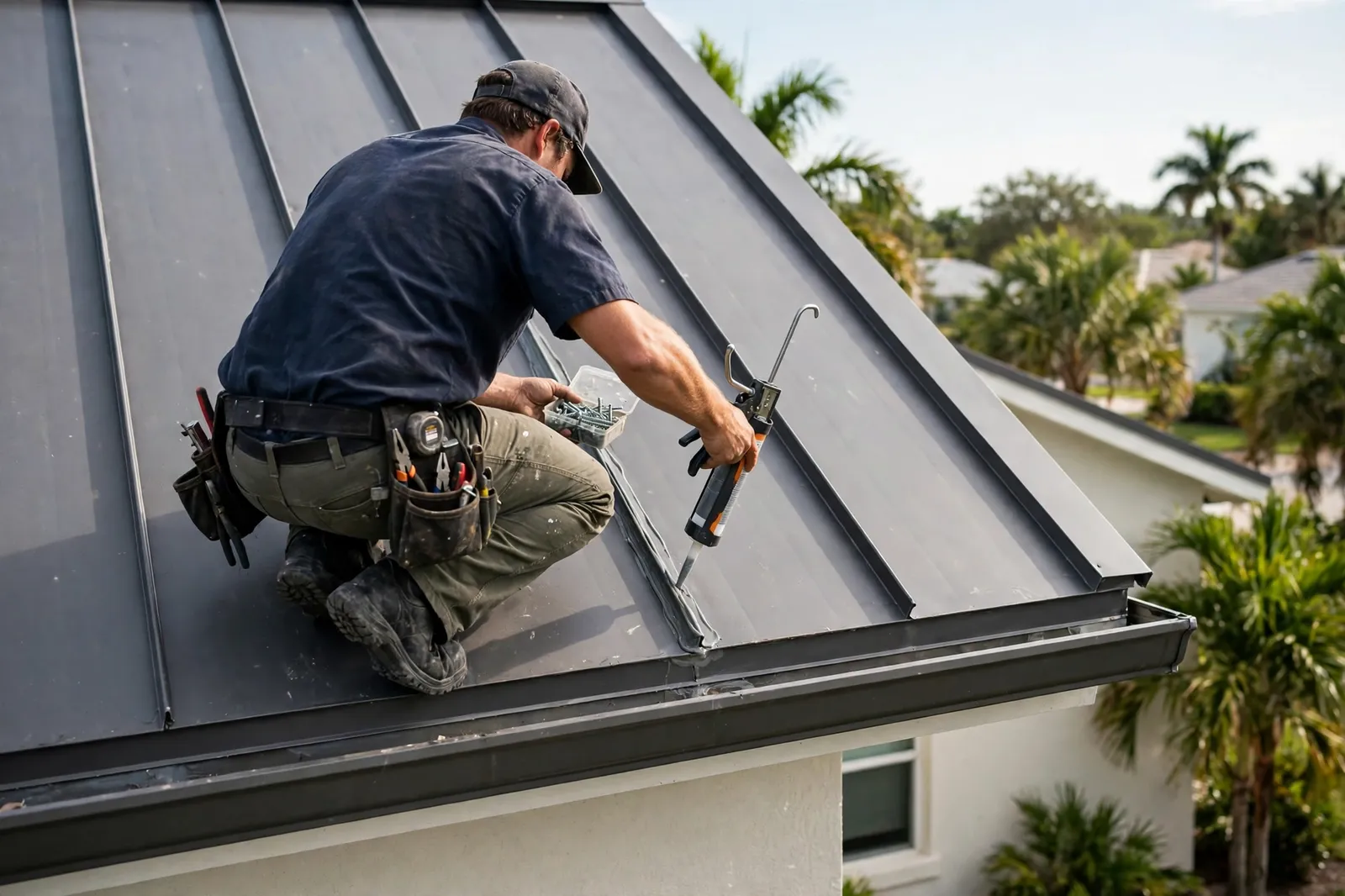
Metal roof repair in Jacksonville covers loose and backed-out fasteners, failed seam sealant, rust treatment at cut edges, flashing renewal, and panel patching on standing seam and exposed-fastener roofs. Call (725) 765-9243 and we will connect you with a local contractor who covers Jacksonville.
What metal roof repairs are most common in Jacksonville?
Metal roof repair in Jacksonville covers loose and backed-out fasteners, failed seam sealant, rust treatment at cut edges, flashing renewal, and panel patching on standing seam and exposed-fastener roofs.
Metal roofs rarely fail in the field of the panel. They fail at fasteners, seams, and edges, which is why repair focuses on the details instead of the surface.
- Fastener replacement with oversized sealed screws where holes have worn
- Seam resealing on standing seam and snap-lock profiles
- Rust treatment and coating at cut edges and scratches
- Flashing renewal at chimneys, valleys, and roof-to-wall joints
- Panel section replacement after limb or debris damage
- Full fastener-pattern audit on roofs past 15 years
The roofer walks the roof checking fastener torque and sealant condition row by row. Backed-out screws are replaced with larger-diameter sealed fasteners, never just tightened into a worn hole. Failed seam sealant is cut out and renewed, rust is treated to sound metal and coated, and every repair is water-tested where the assembly allows.
Metal repair diagnostics start with a pattern read. Fasteners backing out in straight rows point to thermal cycling on that slope's exposure. Random looseness points to installation torque. Rust at one valley points to debris chemistry, usually oak tannin held against the metal. Reading the pattern first is what keeps the repair aimed at the cause instead of the loudest symptom.
Coating decisions on metal follow a sequence: mechanical repairs first, rust treatment second, coating last, and only over a roof whose seams and fasteners test sound. A coating applied over loose rows locks the failure in and makes the eventual repair slower and dearer. The honest quote prices the sequence in stages, so the homeowner can stop after the mechanical stage if the budget requires it.
Jacksonville housing runs from 1920s bungalows in the urban core to post-war ranch homes, 1990s subdivisions, and new master-planned communities at the edges. The St. Johns River bends through the middle of the metro, so humidity, afternoon thunderstorm build-up off the river, and oak canopy shade shape roof ageing on both banks.
The local pattern shifts street by street. Vilano Beach roofs take the metro's most direct ocean weather: salt at every fastener and wind that arrives with no land to slow it. In World Golf Village, open fairway exposure and roofs reaching 20 years together make World Golf Village a first-replacement-cycle community.
How much does metal roof repair cost in Jacksonville?
Most metal roof repair in Jacksonville lands in the $350 to $1,200 minor band; bigger scopes run $1,200 to $3,500.
Scope of the fastener pattern drives the price. Isolated seam and flashing repairs sit in the minor range. A full-roof fastener replacement with resealing across every seam is a larger job and priced accordingly. Panel replacement after damage depends on profile availability and colour match on aged metal.
Repair fasteners are one size up from the originals with bonded sealing washers rated for ultraviolet exposure, because the washer, not the screw, is what ages out. Seam sealants are the neutral-cure type specified for metal, and touch-up coatings are matched to the panel finish system so repairs do not become the roof's most visible feature.
The ranges behave the same way on every job. Small, accessible, and local is the low end. Large, steep, layered, or hiding secondary damage is the high end. A homeowner reading a quote for metal roof repair in Jacksonville should be able to point at the line that places the job where it sits, and a proper quote makes that line obvious.
The metro's metal roofs divide by age into two service populations: the coastal standing seam roofs of the last twenty years, now entering their first detail-maintenance cycle, and the older exposed-fastener roofs on homes, barns, and additions across Clay and north Duval, whose fastener patterns are due or overdue. Local repair scheduling follows that divide, with audits booked before storm season for the older stock.
The full material-by-material breakdown sits in the Jacksonville roof replacement cost guide, so any quote for this work can be checked line by line. The roofer states the exact price after inspection and before any work starts.
Local housing shifts the figure inside the range. Fleming Island: Fleming Island is planned-community housing from the 1990s and 2000s: two-story homes with architectural shingles under HOA colour and material rules. Atlantic Beach: Atlantic Beach housing is small-lot beach bungalows, cottages under the pine canopy, and renovated coastal homes near the Mayport end. Middleburg: Middleburg housing is rural-suburban: ranch homes and manufactured homes on acreage lots, metal-roofed outbuildings, and newer subdivisions along the Blanding corridor.
Warranty paperwork deserves the same attention as the work itself in Jacksonville. The written quote should state what the workmanship warranty covers and for how long, in plain words, before the job starts. Verbal assurances do not survive staff changes or storm seasons; the document does, and homeowners should keep it with the permit record.
Weather windows shape every schedule in Jacksonville. Summer work starts early to beat the afternoon storms, and a crew that watches the radar rather than the clock alone finishes sealed before the rain arrives. Homeowners hear about weather moves from the contractor directly, with the new time stated on the same call.
The final walkthrough closes the work in Jacksonville. The roofer walks the roof and the ground with the homeowner, points to each repaired or replaced detail, and hands over the closing photographs and paperwork. Anything that looks wrong gets named on that walk, while the crew and the ladders are still on site.
What happens when roof damage is left through a wet season?
Left through another storm cycle, a small failure becomes decking rot: water follows the slope and the framing, and the repair grows from a detail fix into section work. Metal repair renews the failed fasteners, seams, or flashing rather than coating over them, so the fix addresses the cause.
What are the signs a metal roof in Jacksonville needs repair?
A drip at a seam during storms means the seal has already failed and water is reaching the deck. Fastener audits belong on the calendar before storm season for any exposed-fastener roof past 15 years, because one loose row can unzip in high wind.
Thermal movement works fasteners loose a fraction at a time over thousands of heat cycles. Sealant at seams ages out in 15 to 20 years of Florida sun. Scratches and cut edges rust first near salt air, and storm debris dents panels and cracks seams.
The visit works in rows: torque-check and replace, seam by seam, then edges and penetrations, finishing with a hose test on the repaired sections where the assembly allows. The roofer photographs a sample of replaced fasteners and the failed seals, so the homeowner sees the pattern evidence behind the invoice rather than trusting a summary.
Timing in northeast Florida follows the storm calendar. The weeks before June are for inspections and the repairs they find, because summer afternoons test every seal on the roof. Autumn is the second window, after the tropical season, when storm damage is documented and planned work books fastest. Metal Roof Repair booked in those windows avoids the post-storm queue entirely.
The causes repeat with local accents. Neptune Beach: Neptune Beach roofs sit within constant salt air reach, and the town's mature palms drop fronds that crack tiles and dam valleys during storm season. Green Cove Springs: The riverfront setting in Green Cove Springs keeps humidity high, and the historic core's steep, older roofs carry layered repairs and ageing flashing that need careful assessment before new work.
From the Trout River to Matanzas Inlet the inputs barely change: daily summer rain, canopy debris, salt near the coast, and heat everywhere. The defects that follow are the metro's shared list, which is why one documented standard covers Jacksonville and all ten cities around it.
Site care is part of how a professional crew works in Jacksonville: landscaping protected before ladders go up, debris into a bin rather than across the yard, and a magnetic sweep for nails before the crew leaves. It costs the roofer little and tells the homeowner a great deal about how the invisible parts of the work above were handled.
A roof file pays off again at resale in Jacksonville. Buyers and their inspectors read the permit record, the dated photographs, and the warranty before they argue about price, and a complete file answers most of their questions before they are asked. Keeping the paperwork from any job arranged through this site is part of the job's value.
Documentation is the thread through every stage of a roofing job in Jacksonville. The inspection photographs the roof before anyone quotes it, the quote prices what the photographs show, and the finished work is photographed again so the file closes with evidence. Homeowners who keep that file hold the strongest position in any later insurance, warranty, or resale conversation.
Repair or re-coat a metal roof in Jacksonville?
Repair while panels are sound: fasteners, seams, and coatings are maintenance, not failure. Consider replacement or a full restoration coating when rust has thinned panel metal, when profiles are discontinued, or when leak points multiply faster than visits can close them.
Work on metal follows the panel manufacturer's repair guidance: no surface screws added through standing seam pans, no incompatible metals in contact, and sealant used as a supplement to mechanical closure, never as the closure itself on a seam that carries water. Those rules are what keep a repair from voiding the original system's logic.
Before the visit, three things help: the age of the roof if it is known, any paperwork from prior work, and a note of exactly where water, noise, or debris has shown itself. None of it is required, and the inspection proceeds without it, but the report gets sharper and the quote gets tighter when the facts arrive with the roofer.
Minor work of this kind typically needs no permit in Duval County. Structural deck work and full replacement need a Duval County permit under the Florida Building Code, and the roofer pulls the permit and schedules the inspections before work starts.
A documented survey through roof inspection in Jacksonville, FL gives the decision its evidence base. My Jacksonville Roofer is a connection service, not a roofing company. The service connects the homeowner with an independent roofer serving Jacksonville in Duval County. One call to (725) 765-9243 starts the process.
Scheduling honesty matters as much as the work in Jacksonville. A roofer who gives a real window, calls when weather moves it, and says plainly where a job sits in the queue is showing the same reliability the roof itself needs. This site passes timing questions through to the contractor on the first call, so expectations are set by the people who will actually do the work.
Materials staging tells its own story on a Jacksonville job. Shingles, panels, or tiles arrive before the tear-off starts, sit protected off the ground, and leave no offcuts scattered through the planting beds. A tidy site at the end of day one is the earliest visible sign of how carefully the hidden layers are being laid.
Metal Roof Repair across the Jacksonville metro
Every city in the metro has its own metal roof repair page, written for its own housing, roads, and weather.
Jacksonville BeachMetal Roof Repair in Jacksonville BeachPonte Vedra BeachMetal Roof Repair in Ponte Vedra BeachOrange ParkMetal Roof Repair in Orange ParkFleming IslandMetal Roof Repair in Fleming IslandAtlantic BeachMetal Roof Repair in Atlantic BeachMiddleburgMetal Roof Repair in MiddleburgNeptune BeachMetal Roof Repair in Neptune BeachGreen Cove SpringsMetal Roof Repair in Green Cove SpringsSaint AugustineMetal Roof Repair in Saint AugustineSaint JohnsMetal Roof Repair in Saint Johns
Popular Jacksonville neighbourhoods for metal roof repairs
Neighbourhood-level metal roof repairs pages sit under their city pages, so homeowners find a page written for their own streets.
Related services in Jacksonville
Metal Roofing in JacksonvilleStanding seam and panel systems rated for Florida wind and coastal airRoof Repair in JacksonvilleLeak repair, shingle replacement, and flashing work with published price rangesRoof Inspection in JacksonvilleEvery slope, the flashing, and the attic, with dated photos and a written summaryRoof Replacement Cost in JacksonvillePublished ranges and the factors that move a quote, so any price can be checkedHow It Works
How do you book through this site?
1
Call
Call (725) 765-9243 and describe the problem: a leak, storm damage, an aging roof, or a cost question.
2
Get connected
We connect you with an independent roofing contractor who covers your part of the Jacksonville metro.
3
Get your roof assessed
The contractor inspects the roof and gives you their price and timeline directly. You decide whether to go ahead.
Metal Roof Repair questions, answered
Plan on a fastener and sealant audit around year 12 to 15, then every 5 years. Florida sun and storm cycles age the rubber washers and seam sealant faster than in northern climates. Standing seam roofs need less of this because their fasteners are concealed. Sealant type matters on metal; the job file records what was used and where.
A quality elastomeric coating over sound, properly prepared metal can add years and stop surface rust progression. Coating over loose fasteners or failed seams seals the problems in, not out. The repair sequence is mechanical first, coating second, and the quote separates both stages. If the panels are sound, budget the audit cycle instead of waiting for the next drip.
They can be. Water enters at a fastener or seam and travels along the panel profile before showing inside. Tracing uses the attic stain pattern and seam-by-seam checks uphill of it. The water test at the end proves the entry point was the right one. Ask for photos of the removed fasteners; their condition explains the whole repair.
A specialist records the address, the panel type if known, and where water shows. The specialist connects the homeowner with an independent roofer serving Jacksonville who works on metal systems. My Jacksonville Roofer is a connection service, not a roofing company. Oversized replacement screws are the standard fix for worn holes; re-tightening alone is not a repair.
Localised seam, flashing, and fastener repairs in Jacksonville sit in the minor repair range of $350 to $1,200. A full fastener-pattern replacement with seam resealing across the roof sits in the larger range of $1,200 to $3,500. The written quote follows a row-by-row roof check. A row-by-row audit report lets the next service visit start from a map, not from scratch.