Roof Replacement - Jacksonville Metro
Roof Replacement in Jacksonville, FL
Across Jacksonville and 10 nearby cities, roof replacement is scoped, documented, and priced in the open. One call connects you with an independent roofer who covers your part of the metro.
Serving Jacksonville and 10 nearby cities Open 24/7 for emergencies
Roof replacement in Jacksonville means a full tear-off to the deck, deck repair where needed, new underlayment, and a new shingle, tile, metal, or flat roof system installed to the Florida Building Code. Call (725) 765-9243 and we will connect you with a local contractor who covers Jacksonville.
What does a full roof replacement in Jacksonville include?
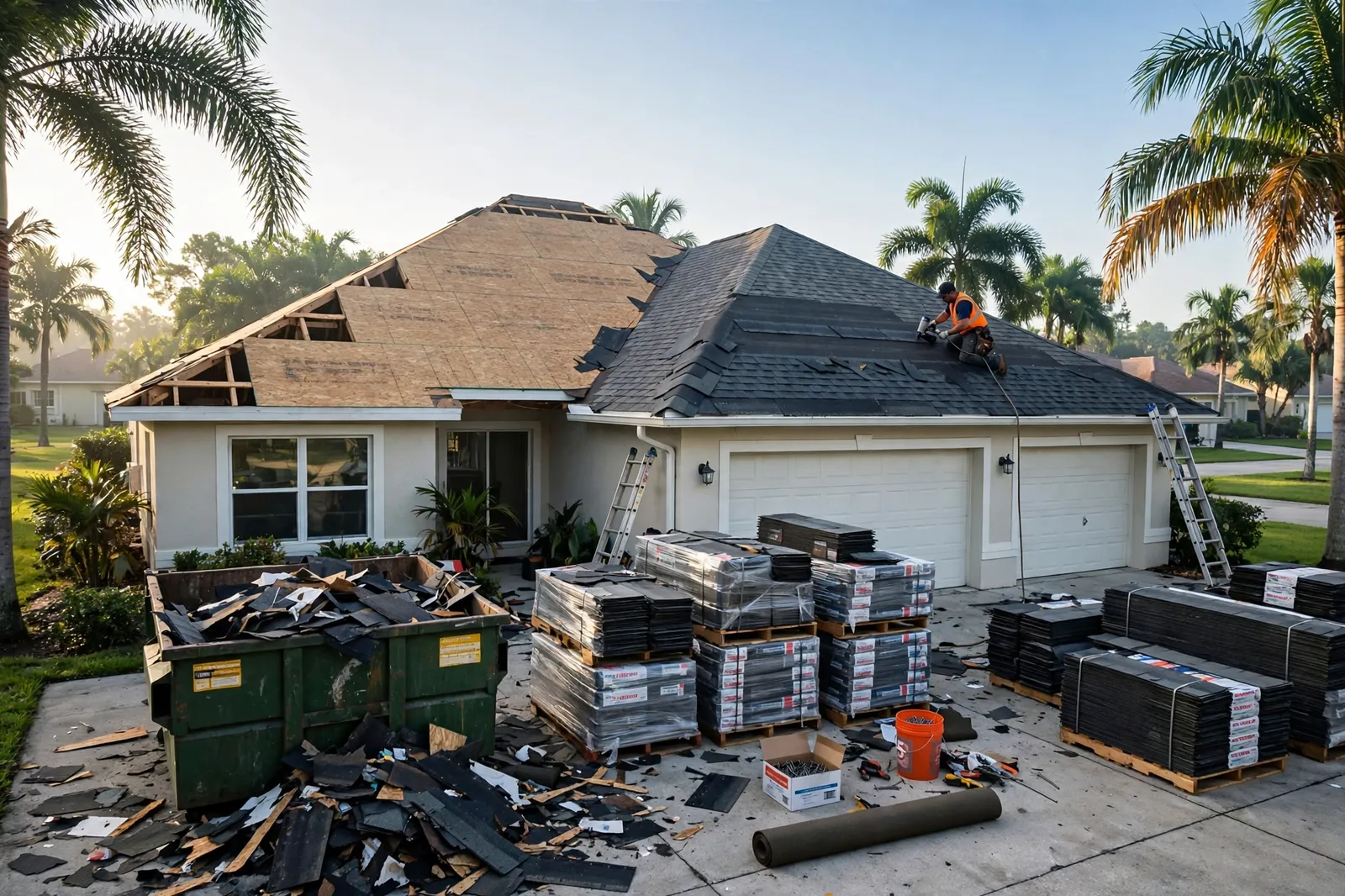
Roof replacement in Jacksonville means a full tear-off to the deck, deck repair where needed, new underlayment, and a new shingle, tile, metal, or flat roof system installed to the Florida Building Code.
Replacement is a system, not a surface. The deck, underlayment, flashing, and ventilation decide how long the new roof lasts as much as the covering does.
- Full tear-off of the old roof down to the decking
- Decking inspection and replacement of rotted sections
- New synthetic underlayment and ice-and-water shield at eaves and valleys
- New architectural shingle, tile, metal, or flat system installation
- New flashing at every chimney, wall, vent, and valley
- Permit, inspections, and manufacturer warranty registration
The job starts with a measured inspection and a written quote that separates tear-off, decking, materials, and labour. On install day the crew protects landscaping, strips the old roof, replaces bad decking, and dries the house in the same day whenever the weather allows. New flashing goes in before the covering, ventilation is checked against the attic size, and the county inspection closes the permit.
The part of replacement nobody sees decides how it ages: the deck and the details under the covering. Decking is sounded and walked, not glanced at, because soft sheets telegraph through new shingles within seasons. Valleys get woven or metal-lined treatment matched to the debris load of the street, and every pipe and vent gets new flashing sized to the penetration, not reused metal with new sealant on top.
Ventilation is designed, not inherited, on a replacement. Intake at the eaves and exhaust at the ridge are balanced to the attic's size, because the old roof's habits (a hot attic, cooked shingles, damp decking) usually trace to ventilation that never matched the house. Correcting it during the one week the roof is open is the cheapest building science a homeowner will ever buy.
Jacksonville housing runs from 1920s bungalows in the urban core to post-war ranch homes, 1990s subdivisions, and new master-planned communities at the edges. The St. Johns River bends through the middle of the metro, so humidity, afternoon thunderstorm build-up off the river, and oak canopy shade shape roof ageing on both banks.
The local pattern shifts street by street. In Northside, Big lots and tall pines give Northside roofs needle load and limb risk, with longer drive times that make complete first visits matter. In Westside, Age is the Westside factor: layered repairs, worn valley metal, and roofs that need an honest repair-versus-replacement read before more money goes in.
How much does roof replacement cost in Jacksonville?
A full roof replacement in Jacksonville runs $12,000 to $38,000 for most homes.
Roof size, pitch, story count, material choice, and decking condition set the price. Architectural shingles anchor the low end of the published range. Tile and standing seam metal sit higher per square. Steep or cut-up roofs with many valleys and penetrations take more labour per square than simple gable roofs.
Homeowners choose among architectural shingles, concrete tile, standing seam or panel metal, and flat systems for low-slope sections, each with different weight, wind rating, and service life. The quote compares the realistic options for that roof rather than steering to one material: shingles for value, tile and metal for decades, with the per-year maths shown.
A worked example keeps the ranges honest. A typical Jacksonville job for roof replacement is measured on site, photographed slope by slope, and priced from the documented scope rather than from a postcode average. Where the inspection finds the deck sound and the damage local, the quote lands in the lower part of the range. Where access, pitch, or hidden damage adds labour, it lands higher, and the quote shows which factor moved it.
Replacement in Jacksonville carries a local signature: wind-zone fastening that tightens toward the coast, underlayment choices made for heat as much as for water, and schedules built around afternoon storms that arrive like clockwork from June to September. A replacement quoted by a roofer who works the metro reads those conditions into the price from the start, instead of discovering them at tear-off.
The full material-by-material breakdown sits in the Jacksonville roof replacement cost guide, so any quote for this work can be checked line by line. The exact figure comes in a written quote after the roof has been measured and inspected.
Local housing shifts the figure inside the range. Neptune Beach: Neptune Beach is a small beach town of cottages, compact ranch homes, and modern infill builds on tight lots a few blocks from the ocean. Green Cove Springs: Green Cove Springs housing includes a historic core of older frame and brick homes near Walnut Street, plus ranch subdivisions from the 1970s onward. Saint Augustine: Saint Augustine housing spans historic-district homes with tile and metal roofs, mid-century neighbourhoods west of US-1, and newer communities toward the county edges.
Documentation is the thread through every stage of roof replacement in Jacksonville. The inspection photographs the roof before anyone quotes it, the quote prices what the photographs show, and the finished work is photographed again so the file closes with evidence. Homeowners who keep that file hold the strongest position in any later insurance, warranty, or resale conversation.
Warranty paperwork deserves the same attention as the work itself in Jacksonville. The written quote should state what the workmanship warranty covers and for how long, in plain words, before the job starts. Verbal assurances do not survive staff changes or storm seasons; the document does, and homeowners should keep it with the permit record.
Why does roof damage need prompt attention?
Roof damage needs prompt attention because water often travels beyond the first visible stain.
When is replacement the right call in Jacksonville?
Replacement is planned work, not emergency work, but timing still matters. Booking outside the peak storm months usually means a faster start. A roof that is actively leaking in several places may need tarping or a larger repair to hold it safely until the install date.
Roofs come due by age and by accumulation: granule loss across every slope, repeated leaks at unrelated points, soft decking, or storm damage on a surface that was already worn. At that point each repair buys less time than the last one.
Most homes follow the same rhythm: day one is tear-off and deck work with same-day dry-in, the middle days are covering and detail work, and the last day is flashing finishes, ventilation checks, cleanup, and the walkthrough. Weather calls are made each morning; a crew that opens a roof watches the radar like it matters, because it does.
There is a right season for this work in Jacksonville. Pre-season, the roof gets inspected and sealed while schedules are open. In season, the same work joins the emergency queue behind active leaks. Homeowners who treat roof replacement as a spring task rather than a storm reaction pay less, wait less, and keep the documentation insurers like to see.
The causes repeat with local accents. Atlantic Beach: Atlantic Beach roofs take direct ocean weather: salt spray at every fastener, sand-laden wind, and pine straw that mats on low-slope sections and in valleys after every storm. Middleburg: Middleburg's pine flatwoods shed needles onto every roof, and big open lots give afternoon storms a clear run at eaves and ridge lines with no neighbouring houses to break the wind.
Across the metro, the pattern repeats from the river to the beaches: afternoon storms build over the St. Johns River, oak canopy holds moisture on shaded slopes, and summer heat ages sealants years faster than northern roofs experience. That is why the same defect shows up across Jacksonville, the Beaches, Clay County, and St. Johns County in the same seasons.
Attic condition quietly decides how roof replacement ages in Jacksonville. Ventilation that moves summer heat out of the attic extends the life of sealants, underlayment, and the covering itself, while a sealed, superheated attic cooks all three. Inspections booked through this site check the attic side as a matter of course, and ventilation corrections are quoted separately when they are found.
Site care is part of how a professional crew works in Jacksonville: landscaping protected before ladders go up, debris into a bin rather than across the yard, and a magnetic sweep for nails before the crew leaves. It costs the roofer little and tells the homeowner a great deal about how the invisible parts of the roof replacement above were handled.
What happens during a replacement in Jacksonville?
The honest test is cost per year. A $2,000 repair on a roof with two years of life left is worse value than replacement. A roof with ten sound years left earns its repairs. The inspection report shows slope-by-slope condition so the decision rests on photos and measurements, not pressure.
A Jacksonville replacement is built to the Florida Building Code for its wind zone: deck re-nailing where the existing pattern falls short, underlayment specifications that rise near the coast, and fastening patterns that follow the manufacturer's high-wind instructions. The permit inspections verify those invisible layers before the covering hides them, which is one reason the permit is protection for the homeowner, not paperwork.
The homeowner's part in a good outcome is documentation. Keep the report, the quote, the permit record, and the warranty in one file. That file is what an insurer reads at renewal, what a buyer reads at sale, and what the next roofer reads before climbing the ladder in five years' time.
Minor work of this kind typically needs no permit in Duval County. Structural deck work and full replacement need a Duval County permit under the Florida Building Code, and the roofer pulls the permit and schedules the inspections before work starts.
A documented survey through roof inspection in Jacksonville, FL gives the decision its evidence base. The introduction is the whole of what this site does in Jacksonville: a specialist takes the call, records the roof problem, and connects the homeowner with an independent roofer covering that part of Duval County. The roofer inspects, quotes, and does the work. Call (725) 765-9243 to start.
Insurance files run through much of this work in Florida. Dated photographs, a written scope, and a clear separation between sudden damage and wear are what a claim needs, and they are produced as a matter of routine on jobs arranged through this site in Jacksonville. The homeowner files the claim; the paperwork arrives ready.
Scheduling honesty matters as much as the work in Jacksonville. A roofer who gives a real window, calls when weather moves it, and says plainly where a job sits in the queue is showing the same reliability the roof itself needs. This site passes timing questions through to the contractor on the first call, so expectations are set by the people who will actually do the roof replacement.
Roof Replacement across the Jacksonville metro
Every city in the metro has its own roof replacement page, written for its own housing, roads, and weather.
Jacksonville BeachRoof Replacement in Jacksonville BeachPonte Vedra BeachRoof Replacement in Ponte Vedra BeachOrange ParkRoof Replacement in Orange ParkFleming IslandRoof Replacement in Fleming IslandAtlantic BeachRoof Replacement in Atlantic BeachMiddleburgRoof Replacement in MiddleburgNeptune BeachRoof Replacement in Neptune BeachGreen Cove SpringsRoof Replacement in Green Cove SpringsSaint AugustineRoof Replacement in Saint AugustineSaint JohnsRoof Replacement in Saint Johns
Popular Jacksonville neighbourhoods for roof replacements
Neighbourhood-level roof replacements pages sit under their city pages, so homeowners find a page written for their own streets.
Related services in Jacksonville
Roof Repair in JacksonvilleLeak repair, shingle replacement, and flashing work with published price rangesRoof Inspection in JacksonvilleEvery slope, the flashing, and the attic, with dated photos and a written summaryMetal Roofing in JacksonvilleStanding seam and panel systems rated for Florida wind and coastal airRoof Replacement Cost in JacksonvillePublished ranges and the factors that move a quote, so any price can be checkedHow It Works
How do you book through this site?
1
Call
Call (725) 765-9243 and describe the problem: a leak, storm damage, an aging roof, or a cost question.
2
Get connected
We connect you with an independent roofing contractor who covers your part of the Jacksonville metro.
3
Get your roof assessed
The contractor inspects the roof and gives you their price and timeline directly. You decide whether to go ahead.
Roof Replacement questions, answered
Standing seam metal and concrete tile carry the longest service lives in northeast Florida, often 40 years or more. Architectural shingles last 20 to 25 years at a lower installed cost. Salt air, shade, and attic ventilation shift those numbers on individual homes. The closed permit record and warranty registration papers are part of the handover, not an afterthought.
Policies pay when a covered sudden event destroys the roof, not when age wears it out. Many Florida policies also apply roof-age schedules that reduce payouts on older roofs. The inspection report documents cause honestly, which is what the claim file needs either way. Material lead times are stated before signing, so the start date in the quote is a real one.
Yes. Replacement is loud during tear-off hours, and pets often do better away for the noisiest day, but the home stays livable and the roof is dried in each night. The crew confirms the daily plan before work starts. Keep the product approval documents; insurers ask for them at renewal on newer roofs.
A specialist records the address, roof age, and material interest. The specialist connects the homeowner with an independent roofer serving Jacksonville who measures, inspects the deck and attic, and quotes in writing. My Jacksonville Roofer is a connection service, not a roofing company. The quote separates the covering price from the per-sheet decking rate, so tear-off findings follow an agreed number.
Full replacement in Jacksonville runs $12,000 to $38,000 for most homes. Architectural shingles sit at the lower end, tile and standing seam metal higher. Roof size, pitch, material, and decking condition set the exact figure, which the roofer confirms in a written quote after a measured inspection. Ask which wind-zone fastening pattern the install follows; it belongs in the written quote.