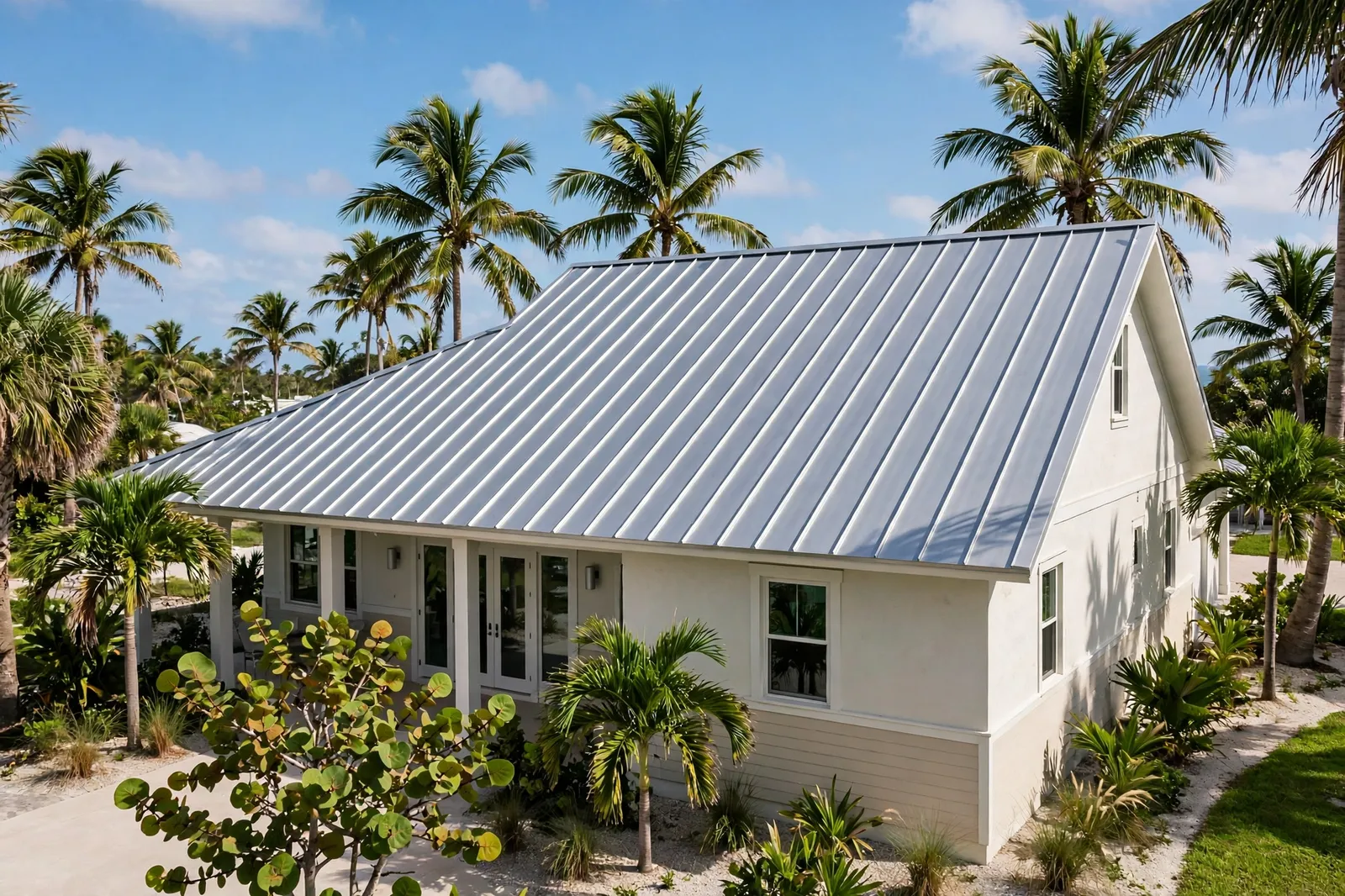
Metal Roofing - Jacksonville Metro
Metal Roofing in Jacksonville, FL
Across Jacksonville and 10 nearby cities, metal roofing is scoped, documented, and priced in the open. One call connects you with an independent roofer who covers your part of the metro.
Serving Jacksonville and 10 nearby cities Open 24/7 for emergencies
Metal roofing in Jacksonville covers standing seam and exposed-fastener panel systems in aluminium and galvalume, installed over new underlayment with concealed or sealed fasteners rated for Florida wind zones. Call (725) 765-9243 and we will connect you with a local contractor who covers Jacksonville.
What metal roofing options suit Jacksonville homes?
Metal roofing in Jacksonville covers standing seam and exposed-fastener panel systems in aluminium and galvalume, installed over new underlayment with concealed or sealed fasteners rated for Florida wind zones.
Metal is a decades-long decision. Panel profile, metal type, and fastening pattern matter more than colour, and all three are settled in writing before panels are ordered.
- Standing seam panels with concealed clips for clean lines
- Aluminium panels for coastal homes where salt air corrodes steel
- Full tear-off, deck check, and high-temperature underlayment
- Ridge, valley, and flashing metal formed to the roof on site
- Colour selection matched to HOA and neighbourhood rules
- Wind-uplift fastening patterns set by the Florida Building Code
Installation starts like any replacement: tear-off, deck inspection, and underlayment rated for metal's heat. Panels are cut and seamed in sequence, with clips that let the metal move as it heats and cools. Every penetration gets formed flashing, not surface sealant, because a 40-year roof cannot depend on caulk.
Panel layout is where metal roofs are won or lost. Runs are planned so seams land away from valleys and prevailing wind joints, eave and ridge closures are foam or metal rather than exposed sealant, and every penetration is flashed with a boot or curb formed for the profile. Those decisions happen on paper before the first panel is cut, and the homeowner can ask to see the layout logic in the quote.
Thermal movement is designed into every metal roof: panels grow measurably on a summer afternoon, and clips, slots, and closures exist to let them. A system installed rigid will oil-can, loosen, or tear at its fasteners within years. The installation documents describe the movement details, and they are worth a homeowner's questions, because they separate metal roofing from metal covering.
Jacksonville housing runs from 1920s bungalows in the urban core to post-war ranch homes, 1990s subdivisions, and new master-planned communities at the edges. The St. Johns River bends through the middle of the metro, so humidity, afternoon thunderstorm build-up off the river, and oak canopy shade shape roof ageing on both banks.
The local pattern shifts street by street. In Lakeside, Lake moisture is the Lakeside factor: north slopes stay damp, algae streaks run early, and lakeside oaks drop debris into every valley. In Argyle Forest, Argyle Forest roofs are one big age cohort: builder shingles from the same build years reaching wear together, with oak shade holding moisture on the north slopes.
How much does a metal roof cost in Jacksonville?
A full metal roofing in Jacksonville runs $12,000 to $38,000 for most homes.
Metal sits in the upper half of the replacement range. Panel profile, metal type, roof complexity, and tear-off condition set the exact figure. Standing seam costs more than exposed-fastener systems and outlasts them, because its fasteners stay hidden from sun and rain.
The metal choice itself is local: aluminium within salt-air reach of the ocean and the wide river, galvalume for inland homes, in gauges matched to span and wind zone. Finishes are factory-applied and carry their own warranties. Colour affects heat load in a Florida attic measurably, and the quote conversation includes the light-versus-dark trade honestly.
A worked example keeps the ranges honest. A typical Jacksonville job for metal roofing is measured on site, photographed slope by slope, and priced from the documented scope rather than from a postcode average. Where the inspection finds the deck sound and the damage local, the quote lands in the lower part of the range. Where access, pitch, or hidden damage adds labour, it lands higher, and the quote shows which factor moved it.
Metal has grown across the metro for local reasons: hurricane memory, salt air at the Beaches that punishes lesser materials, and summer attic heat that a reflective metal roof measurably reduces. Riverside and San Marco wear it over historic homes, the coast wears it for survival, and the new subdivisions wear it as the last roof the owners plan to buy. Each context changes the specification conversation.
The full material-by-material breakdown sits in the Jacksonville roof replacement cost guide, so any quote for this work can be checked line by line. The exact figure comes in a written quote after the roof has been measured and inspected.
Local housing shifts the figure inside the range. Neptune Beach: Neptune Beach is a small beach town of cottages, compact ranch homes, and modern infill builds on tight lots a few blocks from the ocean. Green Cove Springs: Green Cove Springs housing includes a historic core of older frame and brick homes near Walnut Street, plus ranch subdivisions from the 1970s onward. Saint Augustine: Saint Augustine housing spans historic-district homes with tile and metal roofs, mid-century neighbourhoods west of US-1, and newer communities toward the county edges.
Warranty paperwork deserves the same attention as the work itself in Jacksonville. The written quote should state what the workmanship warranty covers and for how long, in plain words, before the job starts. Verbal assurances do not survive staff changes or storm seasons; the document does, and homeowners should keep it with the permit record.
Documentation is the thread through every stage of metal roofing in Jacksonville. The inspection photographs the roof before anyone quotes it, the quote prices what the photographs show, and the finished work is photographed again so the file closes with evidence. Homeowners who keep that file hold the strongest position in any later insurance, warranty, or resale conversation.
Why does roof damage need prompt attention?
Roof damage needs prompt attention because water often travels beyond the first visible stain.
When is metal the right choice in Jacksonville?
Metal is planned work with longer lead times: panels are ordered to measure, and colour choices can add weeks. Starting the quote outside storm season keeps the schedule comfortable. A leaking current roof can be secured with repair work while the metal is fabricated.
Homeowners choose metal after replacing shingles twice, for storm country peace of mind, or for a home they plan to keep for decades. Salt air near the coast pushes the choice toward aluminium, which does not rust at cut edges the way coated steel can.
Fabrication drives the calendar. Panels are measured, ordered or formed, and delivered before tear-off begins, so the home is never open waiting on metal. Install runs slope by slope with same-day closure, and the finishing work (ridge, valleys, and penetration flashings) is the slow, careful part that decides the next forty years.
There is a right season for this work in Jacksonville. Pre-season, the roof gets inspected and sealed while schedules are open. In season, the same work joins the emergency queue behind active leaks. Homeowners who treat metal roofing as a spring task rather than a storm reaction pay less, wait less, and keep the documentation insurers like to see.
The causes repeat with local accents. Saint Augustine: Salt air, a dense historic tree canopy, and nor'easters that push rain for days shape roof wear in Saint Augustine. Historic-district rules can also govern visible materials and colours. Saint Johns: Newer Saint Johns roofs are reaching their first repair cycle together, so sealant failure, vent boot splits, and builder-grade flashing details appear across whole streets in the same seasons.
Across the metro, the pattern repeats from the river to the beaches: afternoon storms build over the St. Johns River, oak canopy holds moisture on shaded slopes, and summer heat ages sealants years faster than northern roofs experience. That is why the same defect shows up across Jacksonville, the Beaches, Clay County, and St. Johns County in the same seasons.
Site care is part of how a professional crew works in Jacksonville: landscaping protected before ladders go up, debris into a bin rather than across the yard, and a magnetic sweep for nails before the crew leaves. It costs the roofer little and tells the homeowner a great deal about how the invisible parts of the metal roofing above were handled.
Attic condition quietly decides how metal roofing ages in Jacksonville. Ventilation that moves summer heat out of the attic extends the life of sealants, underlayment, and the covering itself, while a sealed, superheated attic cooks all three. Inspections booked through this site check the attic side as a matter of course, and ventilation corrections are quoted separately when they are found.
What does metal roof installation involve in Jacksonville?
Metal wins on cost per year when the homeowner keeps the home long term. Shingles win on upfront price when the horizon is shorter. The quote conversation covers both honestly, including the fact that metal roofs also reduce attic heat load in the Florida summer.
Metal systems are installed to their product approvals: clip spacing, seam height, and fastener patterns all follow the tested assembly for the home's wind zone, because the approval is what the wind rating rests on. Substituting a cheaper clip or skipping a closure voids the engineering the homeowner paid for, which is why the quote names the system, not just the metal.
The homeowner's part in a good outcome is documentation. Keep the report, the quote, the permit record, and the warranty in one file. That file is what an insurer reads at renewal, what a buyer reads at sale, and what the next roofer reads before climbing the ladder in five years' time.
Minor work of this kind typically needs no permit in Duval County. Structural deck work and full replacement need a Duval County permit under the Florida Building Code, and the roofer pulls the permit and schedules the inspections before work starts.
A documented survey through roof inspection in Jacksonville, FL gives the decision its evidence base. My Jacksonville Roofer is a connection service, not a roofing company. The service connects the homeowner with an independent roofer serving Jacksonville in Duval County. One call to (725) 765-9243 starts the process.
Scheduling honesty matters as much as the work in Jacksonville. A roofer who gives a real window, calls when weather moves it, and says plainly where a job sits in the queue is showing the same reliability the roof itself needs. This site passes timing questions through to the contractor on the first call, so expectations are set by the people who will actually do the metal roofing.
Insurance files run through much of this work in Florida. Dated photographs, a written scope, and a clear separation between sudden damage and wear are what a claim needs, and they are produced as a matter of routine on jobs arranged through this site in Jacksonville. The homeowner files the claim; the paperwork arrives ready.
Metal Roofing across the Jacksonville metro
Every city in the metro has its own metal roofing page, written for its own housing, roads, and weather.
Jacksonville BeachMetal Roofing in Jacksonville BeachPonte Vedra BeachMetal Roofing in Ponte Vedra BeachOrange ParkMetal Roofing in Orange ParkFleming IslandMetal Roofing in Fleming IslandAtlantic BeachMetal Roofing in Atlantic BeachMiddleburgMetal Roofing in MiddleburgNeptune BeachMetal Roofing in Neptune BeachGreen Cove SpringsMetal Roofing in Green Cove SpringsSaint AugustineMetal Roofing in Saint AugustineSaint JohnsMetal Roofing in Saint Johns
Popular Jacksonville neighbourhoods for metal roofings
Neighbourhood-level metal roofings pages sit under their city pages, so homeowners find a page written for their own streets.
Related services in Jacksonville
Metal Roof Repair in JacksonvilleFasteners, seams, and rust treated before small failures become leaksRoof Replacement in JacksonvilleFull tear-off and re-roof with line-item written quotes and permit handlingTile Roof Repair in JacksonvilleCracked tiles and the underlayment beneath them, repaired in sectionRoof Replacement Cost in JacksonvillePublished ranges and the factors that move a quote, so any price can be checkedHow It Works
How do you book through this site?
1
Call
Call (725) 765-9243 and describe the problem: a leak, storm damage, an aging roof, or a cost question.
2
Get connected
We connect you with an independent roofing contractor who covers your part of the Jacksonville metro.
3
Get your roof assessed
The contractor inspects the roof and gives you their price and timeline directly. You decide whether to go ahead.
Metal Roofing questions, answered
A properly installed standing seam roof lasts 40 to 60 years in northeast Florida. Aluminium performs best near the coast. Exposed-fastener systems need a fastener and seal refresh at 15 to 20 years, which the installing roofer documents at handover. The clip and closure details are the warranty's foundation; they are named in the install documents.
Over a solid deck with underlayment and an insulated attic, rain noise is about the same as a shingle roof. The tin-roof drumming people imagine comes from metal over open framing on barns and sheds, not from residential assemblies. Ask which product approval the quoted system carries; the wind rating lives in that document.
Metal systems carry some of the highest wind ratings available when the fastening pattern follows the code for the home's wind zone. Interlocking seams and concealed clips resist the uplift that peels shingle tabs. The quote states the rating the installed system is built to. Aluminium within salt reach is a specification, not an upgrade sell; the quote should say which metal is priced.
Aluminium panels do not rust, which is why they are specified within salt-air distance of the ocean and the river. Galvalume performs well inland. Cut edges and penetrations are sealed and flashed at install, the details that decide coastal performance. Panel lead time belongs in the quote, so the start date is honest before signing.
Some systems allow it, but tear-off is the recommendation in Florida. The deck cannot be inspected or re-nailed to current code through an old roof, and trapped moisture shortens the new system's life. The quote prices tear-off openly rather than burying the risk. Colour choice affects attic heat; ask for the light-colour numbers if cooling costs matter.